The empty shell on the showroom floor is not the load your joists have to carry. A filled spa, with people in it, is a concentrated live load that most backyard decks in San Diego County were never framed for. Before a crane swings over a Clairemont fence or a Mission Hills retaining wall, a licensed deck builder needs to know whether that frame can take it.
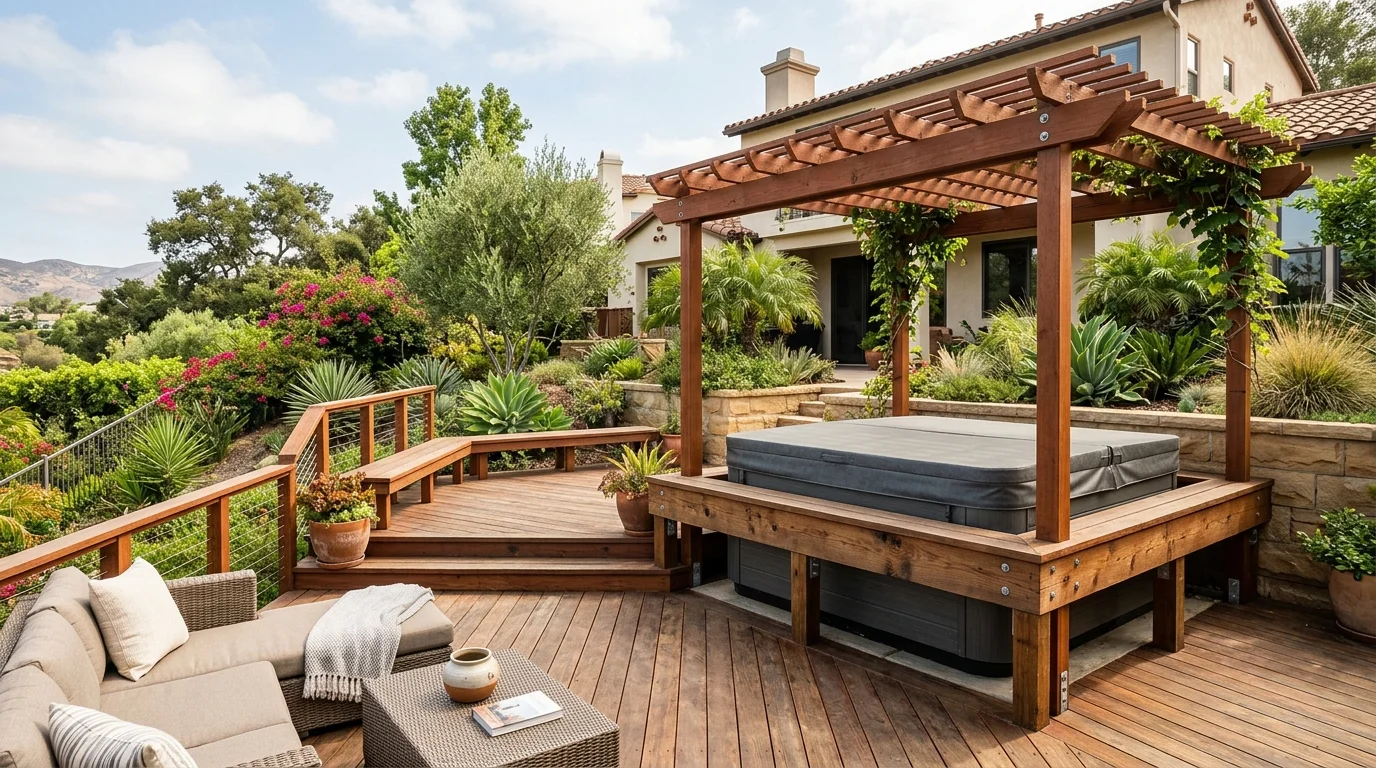
A spa is a live-load problem first, a weekend upgrade second
People shop a spa the way they shop patio furniture. They pick a size, a cover, and a corner with a canyon view. Then they book delivery.
The frame does not care about the view. It cares about weight that sits in one place, for years, through marine layer, Santa Ana heat, and the odd hard rain.
A lot of decks in this county were built as outdoor rooms. Mission Beach bungalows. 1970s El Cajon ranch houses. Hillside walk-outs in Tierrasanta and Fletcher Hills. They were sized for chairs, a grill, and a few people standing at the rail. They were not sized for a water-filled vessel that never moves.
If the walking surface sits more than 30 inches above grade, California already requires a 42-inch guard. That is a California figure. National deck articles often quote 36 inches, which is the wrong number here. A spa on an elevated deck does not relax that rule. It packs more people at the edge, and a fall from that height is worse, not better.
On a building with three or more multifamily units, a wood deck more than six feet above grade is an exterior elevated element under California Health and Safety Code 17973. Condos and HOAs also have Civil Code 5551 inspection rules. Deck Pro SD does not perform those inspections and does not employ inspectors. It matches owners with independent licensed professionals. If your spa plan sits on a balcony that already has an inspection clock, say so before anyone cuts a chase for a 240-volt line.
City of San Diego addresses go through the Development Services Department. Unincorporated county lots do not. The crew we match you with pulls the permit in its own name when the work needs one, and schedules the inspections. Replacing boards like-for-like usually does not require a permit in San Diego. Changing structural members, loading, or configuration often does.
A pool and spa deck built for wet feet around an in-ground vessel is a different job from setting a portable spa on an existing framed deck. So is choosing a pool deck surface. This decision is the framed-deck case: load path first, soak second.
Why the brochure weight is not what the joists feel: water, people, and point load
The dry shipping weight is the number on the sticker. Joists feel the filled weight, plus people, plus the cover, plus the small patches of framing the shell actually sits on.
A spa does not spread load like a party walking around. It bears on a few pads, feet, or a rim. That is a point load. Blocking, doubled joists, and posts under that footprint matter more than how the whole deck feels when you bounce on an empty corner.
There is no single published pounds-per-square-foot figure that covers every San Diego deck and every spa model. Tub makers publish empty and filled weights for each model. Ask for both, in writing. Then have the licensed contractor, and an engineer if they ask, size the span, species, and footings to that number. A chart copied from a national how-to page is not a calculation for your lot.
Water is most of the mass. People add more when every seat is full. A swim spa is a different class of load than a four-person shell. Do not treat them as the same project, and do not set either one on a deck because a neighbor’s tub “has been fine for years.”
Climate does not add capacity. Coastal lots in Encinitas, La Jolla, and Imperial Beach keep wood damp with salt air. Inland lots in Ramona, Escondido, and El Cajon cook fasteners and coatings in summer heat. Older housing stock is the other half of the story. Del Mar and La Mesa have a larger share of homes built before 1978 than most of the county. Alpine and San Marcos run newer. An old ledger and undersized joists are a common reason a “set it in the corner” plan fails.
If the matched pro finds rot at the ledger, post bases, or joist ends, that is a repair or rebuild conversation before a spa is in the picture. Targeted deck repairs in San Diego run $500 to $8,000 depending on scope. Full structural repair or rebuild of the affected section runs $8,000 to $25,000. Most repairs finish in 1 to 5 days. Structural rebuilds take 1 to 3 weeks. Those ranges are for the deck work. Deck Pro SD does not publish a package rate for setting a spa on a deck, and it does not set the crew’s price. The matched pro quotes the actual job.
Pad beside the deck vs on the deck, and when the frame should not take it
A concrete or paver pad beside the deck is often the cleaner answer. The spa sits on grade. The deck meets it with a step or a landing. The frame never takes the filled weight.
That layout usually wins when the existing deck is light framing, the yard is flat enough for a pad, power and drainage can run without punching through a bedroom, and a crane or dolly can reach the side yard. National City and Imperial Beach lots are often tight, but many still have a grade-level pocket a pad can use. A Clairemont or Kearny Mesa backyard with a slab already in place is the easy version of this.
On-deck placement makes sense when the yard is a slope, a canyon, or a small lot with no grade-level pocket. Hillside homes in La Jolla, Del Mar, and East County often have the outdoor room in the air. Then the spa is a structural addition, not a furniture drop. Treat that as elevated framing, not as a weekend set.
The frame should not take a spa when you can feel bounce at the corner, posts have settled, the ledger was never flashed, the deck is a second-story floor over a bedroom with no waterproofing assembly, or the structure is a floating platform with no positive connections back to a load path. Those are stop signs. They are not items to “watch after the tub is in.”
A pad still needs a level, drained base. Expansive clay in parts of East County and fill lots in the South Bay are not the same as a Kearny Mesa slab. The spa dealer and the deck builder should not assume the other one designed the pad. Ask who is responsible for soil, thickness, and drainage before anyone pours.
Guards, stairs, and landings still apply where the walking surface is more than 30 inches up. Stairways need at least 36 inches of clear width above the handrails, and a handrail on at least one side of a run with four or more risers. Exterior doors still need a landing. None of that goes away because the spa sits next to the boards instead of on them.
Waterproofing and drainage if the tub sits over living space or a patio
If the tub sits over open dirt, splash and overflow still rot posts and the ledger. If it sits over a patio, the people under it will notice every drip. If it sits over living space, the deck is a roof.
San Diego’s dry months hide a slow leak. Then a February storm makes it obvious.
A spa shell sheds water at the cover, the overflow, and the equipment bay. On a framed deck that water wants to follow fasteners into the ledger and the house band. Under-deck drainage is the system that catches it and sends it to a downspout, not into the room or the patio below.
Over a bedroom, a family room, or a garage, coating and flashing are not optional cosmetics. They are the assembly. The matched pro should treat that as waterproofing work with a drainage plan, not as a bead of caulk around the rim. A rooftop or balcony deck over occupied space is the same class of problem, even when the spa is small.
Coastal marine layer keeps wood wet longer. Inland heat cooks coatings. Pick the membrane and the drainage details for the microclimate. Encinitas and Coronado are not Ramona. A detail that dries in East County can stay wet for weeks near the water.
Do not drain spa water onto a neighbor’s slope, a canyon, or a storm inlet because it is convenient. Ask the city or county how discharge is handled at that address. The rule is local.
Electrical, plumbing, and mechanical work needs its own permit even when a small structure itself is exempt from a building permit. A fill line, a dedicated drain, or a heater circuit can bring permit scope back in. The crew checks before quoting.
Power, fill lines, and how the tub actually gets into the yard
Most residential spas need a dedicated electrical circuit. Do not guess the amperage from a forum post. Read the tub’s nameplate and have a licensed electrician size the run. Electrical work is permitted separately from the deck framing.
People search a “5 foot rule” for hot tubs. That phrase is not a San Diego deck-permit number that applies the same way on every lot. Electrical clearance, property-line setback, and equipment location are set by the code the local department enforces at that address. Ask the spa installer and the building department reviewing the lot. Inside the City of San Diego, start with Development Services. County lots ask the county.
Fill is often a hose on day one and a top-off after that. A planned overflow and a place for that water to go beat a garden hose draped over a railing for years. On a second-story deck, dragging a hose through the house is how floors get ruined.
Getting the tub in is the part dealers underplay on hillside lots. Coronado and parts of Pacific Beach may have a wide enough side yard. A Mount Helix, Bankers Hill, or La Jolla canyon lot may not. Options are a crane from the street, a long carry, or a different product that can be built in place. Measure the gate, the stairs, the overhead lines, and the turning radius before you buy the shell. A tub that cannot reach the pad is still a tub you paid for.
Confirm the contractor on the CSLB license lookup. The pros we connect you with are licensed and insured. Check the number anyway. It is a public tool, and it takes a minute.
Confirm span, species, and footings with the licensed pro and an engineer if they ask
Bring the tub’s filled-weight sheet. Bring photos of the underside, the ledger, and the post bases. Bring the address.
The licensed deck builder looks at joist span, species, condition, post size, footing size, and how the load path hits the soil or the house. If they want an engineer, that is the right call on a heavy point load, especially on a hillside or over living space. Permits and structural work is that process: drawings, the jurisdiction, and inspections. Deck Pro SD pulls no permit, files nothing, and is not a party to it. The independent crew matched to the job pulls the permit in its own name.
Do not size joists from a national spa blog. Do not reuse a neighbor’s “it held fine” as engineering. Species, span, and age differ from Pacific Beach to Alpine. A redwood deck from the 1980s in La Mesa is not a new framed platform in San Marcos.
Like-for-like board replacement usually does not require a permit in San Diego. Replacing structural members (ledger boards, joists, beams, posts) often does, especially if the repair changes the loading or configuration. Setting a spa is a loading change. The crew checks before quoting and pulls the permit when required.
Deck Pro SD is a referral service. It matches you with licensed, independent local deck builders. It does not own crews, trucks, or a yard, and it does not warranty the work. You contract and pay the professional directly.
When to call us
If you want a spa on or beside a framed deck in San Diego County, talk to a licensed deck builder before the dealer books the truck. Call us at (858) 400-4918, leave a message, and we’ll connect you with a licensed local deck builder.