A spongy board in Imperial Beach, a wobbly rail in La Mesa, a dark stain at the ledger in Escondido. Those three calls all show up as deck repair San Diego work, and each one is a different job. The coast, the sprinklers, and inland heat take a deck apart in a different order. The licensed pro you hire has to read that order before anyone prices the work.
The jobs people actually call about: boards, rails, stairs, ledger, and posts
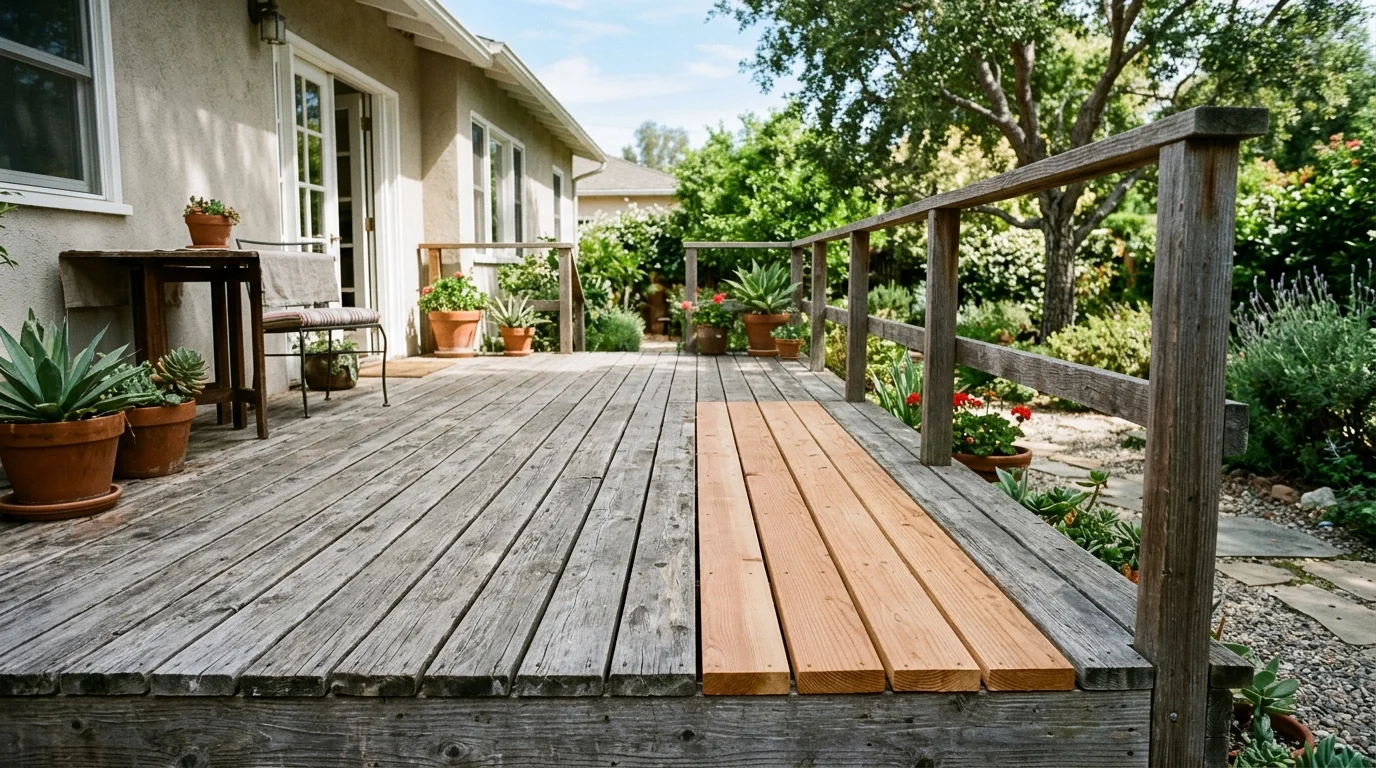
Most calls start at the walking surface. A board cups, splits, or sinks under a heel. On wood decks that is the first thing you see. It is often the smallest part of the job when the framing is still sound.
Rails come next. A post that rocks in your hand. A baluster that has pulled its fastener. A cable that has gone slack. In California, a guard is required along open sides more than 30 inches above the grade below. That guard has to be 42 inches high on a deck walking surface. Openings cannot pass a 4-inch sphere. A finished repair includes that height and that gap, even when the boards look new.
Stairs fail on their own schedule. Thin treads. Uneven risers. A handrail that stops short of the last step. Residential stairs keep riser height at 7-3/4 inches or less, and the tallest riser in a flight cannot beat the shortest by more than 3/8 inch. Treads run at least 10 inches deep. A handrail is required on any continuous flight with four or more risers. The matched crew measures the whole run, including the landing.
Then the ledger. That is the board that bolts a house-attached deck to the wall. Look for staining on the siding, soft wood at the bolts, or flashing that has pulled free. Ledger failure is the job that turns a surface repair into a structural one. The close-up lives in deck dry rot and ledger board repair in San Diego, because that joint is where roof runoff, planters, and spray irrigation actually sit.
Posts and post bases close the list. A post that has wicked water off a slab. A metal base rusted through. A connection that no longer carries load. Targeted work at a ledger, joist, or post base is the common structural scope. Replacing a few boards while those connections stay hidden is how the same call comes back.
Deck restoration San Diego work is this mix: surface, rails, stairs, ledger, posts. The licensed pro names which of those five actually failed before anyone talks dollars.
How marine layer, irrigation, and inland heat each create a different failure
San Diego County is not one climate. A deck two miles from the beach fails in a different order than a deck in Ramona.
Along the coast, from Imperial Beach through Ocean Beach, La Jolla, Encinitas, and Carlsbad, the marine layer is the nightly wet. Boards stay damp after sunset. Fasteners corrode faster in salt air. Shade under an eave or a second-story walkout keeps wood from drying. West-facing ledgers on older coastal houses take the worst of it. Del Mar’s housing stock is older than most of the county, with 69.4% of homes built before 1978. Imperial Beach sits at 62%. Those older decks were often built with flashing details that do not match current practice.
Irrigation is the inland-suburb version of the same water. A spray head in Clairemont, Rancho Bernardo, or Chula Vista that hits the ledger every morning will rot a joint that barely sees rain. Over-spray at post bases is just as common. The failure looks like age. The cause is a clock that runs every day.
Inland heat works the other way. Escondido, El Cajon, Alpine, and Ramona bake boards, check the grain, and pull fasteners as wood shrinks. A south-facing rail in East County can splinter while the ledger is still dry. Alpine’s housing is newer than most of the county, at 31.6% built before 1978, so the failure is often sun and irrigation. Escondido sits near the county median at 43.2% pre-1978. You still see original ledgers on those mid-century houses.
The matched pro has to know which of those three is in play. Tell them the city, the exposure, and whether sprinklers hit the frame. That is local information a photo of one board cannot give.
Repair vs replace is a separate decision
This page is the repair work itself. Keep-or-rebuild is a different call, and it lives on repair or replace a deck in San Diego.
A repair is worth doing when the failure is bounded. A run of boards. A stair flight. A rail section. A ledger or a handful of joists that can be replaced without taking the whole frame. Targeted deck repairs at a ledger, joists, or post base commonly run $500 to $8,000 depending on scope. A full structural repair or rebuild of the affected section commonly runs $8,000 to $25,000. Those ranges are the published figures on deck repair and restoration. They are a market range, not a bid for your address.
Replacement starts to win when the damage is everywhere at once. Soft joists in more than one bay. A ledger that has stained the rim joist inside the house. Posts that have lost section at grade on a hillside lot in La Mesa or Spring Valley. At that point you are stacking repair prices toward a new frame.
Whether it is worth repairing is that test. If the structure can take the load and the water path can be closed, repair is the work. If the frame is the failure, you are in the other article.
Structural members, stairs, and guards belong with a licensed contractor. Confirm the person you hire on the Contractors State License Board license lookup. Deck Pro SD matches you with licensed, independent local deck builder professionals. The brand holds no trade license and does none of the physical work.
What drives a repair quote
A repair quote is a list of failed parts, access, and whether the building department is in the job. It is not a flat square-foot number.
Scope is first. One board is a different job than a ledger. A rail post is a different job than a stair rebuild. The pro has to lift boards, probe joists, and look at post bases before the number means anything. Photos help. They do not replace that look.
Access is second. A ground-level deck in Mission Valley is a different labor picture than a second-story walkout over a canyon in Tierrasanta or a bluff lot in Point Loma. Hauling lumber through a house, working over a finished patio, or staging on a slope all move the quote.
Material match is third. Like-for-like board replacement on an older redwood deck in South Park is a different buy than swapping a few composite boards a mill no longer runs. The crew will say if a clean match is gone.
Hardware and flashing are fourth. Coated or stainless fasteners at the coast. Flashing that actually kicks water out at the ledger. Those details are part of the quote because they are part of the repair.
Permit status is fifth. Like-for-like board replacement usually does not need a permit in San Diego. Replacing structural members often does, especially if the repair changes loading or layout. Permit fees are set by the city or the County of San Diego. Ask the department that will review the address for the current fee. That figure is theirs to publish.
Homeowners insurance is its own question. Coverage depends on the cause and on the policy. Ask the insurer in writing before you assume a payout. Deck Pro SD does not file claims and cannot tell you what a given policy will pay.
Most repairs finish in 1 to 5 days. Structural rebuilds of the affected section take 1 to 3 weeks. That is how long the work itself tends to run once it starts.
Permits on a repair: when the building department gets involved
Like-for-like board replacement usually does not require a permit in San Diego. Replacing structural members (ledger boards, joists, beams, posts) often does, especially if the repair changes the loading or the configuration.
The independent crew matched to the job checks that before quoting. When a permit is required, that crew pulls it in its own name and schedules the inspections. Deck Pro SD pulls no permit, files nothing, and is not a party to it.
Inside the City of San Diego, building permits and plan review run through the Development Services Department. Properties in unincorporated county land are reviewed by the county, not the city. Chula Vista, Oceanside, Escondido, El Cajon, and the other incorporated cities run their own counters. The requirement for a given address is a question for the jurisdiction reviewing it.
Guards and stairs pull the department in even when the homeowner thinks of the work as a rail fix. A 42-inch deck guard, a 4-inch sphere rule, a 34-to-38-inch handrail, a 36-inch stair width: those are the checks an inspector uses. If the repair changes those elements, expect the counter to want a permit.
Multifamily is a different statute. Buildings with three or more multifamily dwelling units have inspection duties for exterior elevated elements under California Health and Safety Code 17973. Condos and HOAs have a parallel duty under Civil Code 5551. Deck Pro SD does not perform those inspections. It matches property owners with independent licensed professionals. The statutory inspection itself has to be done by one of the qualified people the statute names. If you already have that report, bring it. That document is the scope.
How to describe the problem so a licensed pro shows up ready
A licensed pro quotes faster when the first message is specific. City, what moved, and what you already saw.
Name the city and the exposure. “Second-story deck in Encinitas, west side, sprinklers hit the ledger” is usable. “The deck is old” is not.
Name the part. Board, rail, stair, ledger, or post. If the floor feels soft near the house, say that. If a rail post spins, say that. If a stair tread flexes, say that.
Name what you already did. A board you pulled. A flashlight look at the joists. A photo of staining on the siding. Leave the rest of a raised structure in place until the licensed crew is on site.
Ask for a license number and check it on the CSLB lookup before anyone starts. How to pick a deck builder in San Diego walks through that check and the questions that belong in the first conversation.
The deck repair contractors San Diego homeowners actually need are the ones who will name the failed part, say whether the city or the county is in the job, and put the permit in the crew’s name when one is required. A voicemail that lists city, part, and photos is enough to start the match.
When to call us
When a rail moves, a stair flexes, or the boards near the house feel soft, that section needs a licensed deck builder. Deck Pro SD matches you with independent local pros for the repair across San Diego County. Call us at (858) 400-4918, leave a message, and we’ll connect you with a licensed local deck builder.