Searching for deck repair contractors near me often starts with one troubling board or a loose railing. The real decision is whether the problem stops at the surface or reaches the supporting frame. A licensed local deck builder should inspect that structure before recommending repair or replacement.
Start with five structural checks
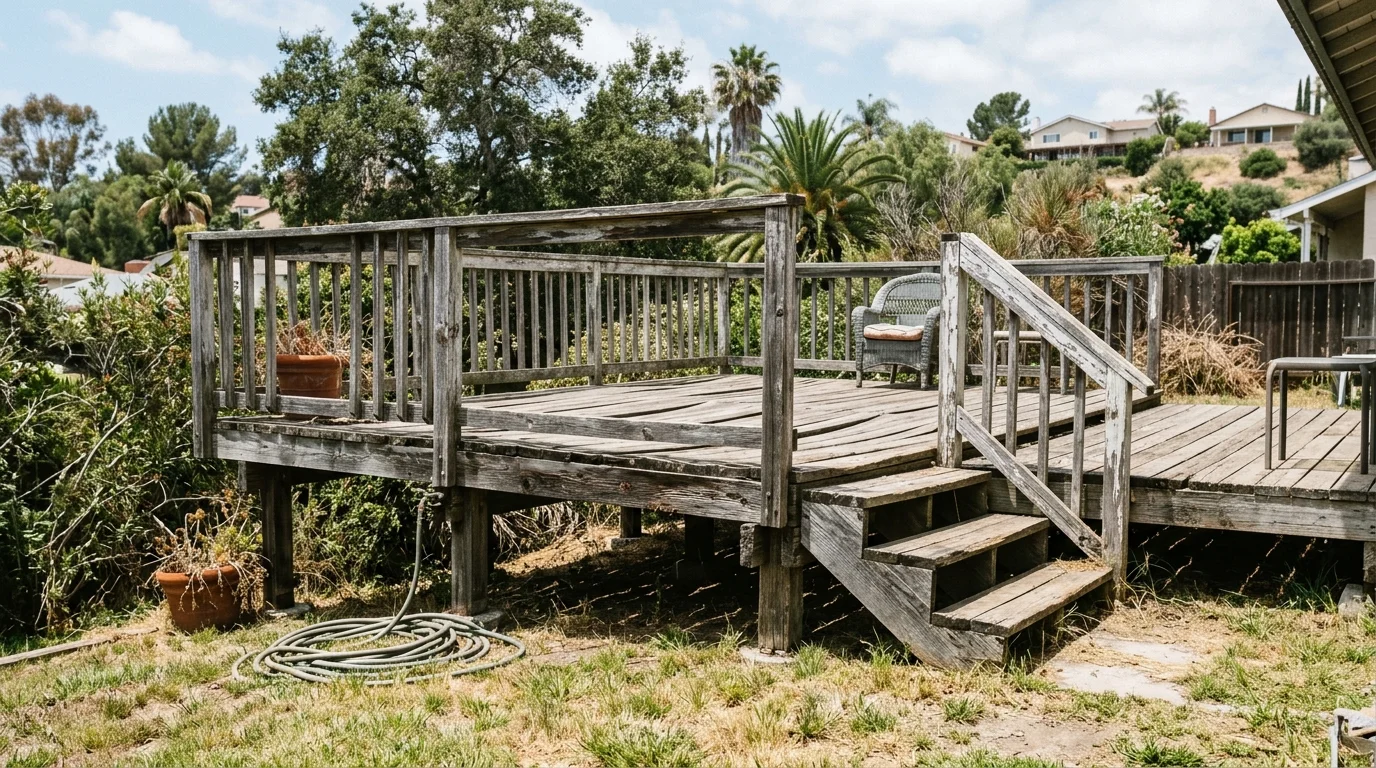
A useful deck assessment begins below the walking surface. Ask the contractor to document five areas: the ledger, posts and footings, joists and beams, connections, and guards.
The ledger is the framing member where an attached deck meets the house. The contractor should explain whether it can remain and show any damaged areas. Photos help you compare that finding with the proposed repair.
Posts and footings deserve their own notes. Ask whether movement or deterioration appears isolated to one support. The answer matters because replacing one affected component differs from rebuilding a connected support system.
Joists and beams carry the deck beneath its boards. A good scope identifies which members need attention. It should also distinguish localized damage from conditions found across several connected members.
Connections include the hardware joining those parts. Don’t accept “the framing is bad” as a complete diagnosis. Ask which connections need correction and how that work affects nearby framing. Exact connection details depend on the approved project design and local review.
Guards and stairs are part of the assessment too. California requirements include a 200-pound concentrated-load standard for guards and handrails. Don’t conduct an improvised load test yourself. Ask the licensed contractor how the existing system will be evaluated.
These checks won’t produce the same answer for every deck. They give you a component-by-component record. That record makes the repair-versus-replacement recommendation easier to judge.
Judge the frame, not the surface
There isn’t a confirmed San Diego rule that turns a fixed percentage of damaged framing into mandatory replacement. We couldn’t verify a city or county threshold such as 25 or 50 percent. The licensed contractor develops the scope, while the property’s building department decides what requires approval.
The practical dividing line is whether damaged components can be isolated. A repair may make sense when the contractor identifies specific members that can be replaced without abandoning the remaining support system. Replacement becomes easier to justify when the recommendation covers several connected parts, such as the ledger, beams, posts, and joists.
Ask for that reasoning in writing. “Old deck” isn’t a component or a scope. Neither is “looks worn.” The proposal should identify what stays, what goes, and why each item belongs in that category.
Also ask what the deck will be after the proposed work. A surface repair, structural repair, and affected-section rebuild are different scopes. The wording should match the work.
San Diego County includes coastal communities, inland neighborhoods, hillside lots, and dense city properties. Don’t rely on a rule of thumb borrowed from another project. Access, jurisdiction, existing framing, and the proposed design all belong in the contractor’s assessment.
If a contractor cites a percentage as the deciding rule, ask for its source. Your local building department can confirm permit requirements. The contractor should support the replacement recommendation with findings from your deck, not a slogan.
Surface wear doesn’t automatically mean replacement
Gray boards, splinters, popped fasteners, and failed stain can look severe. If those conditions are truly limited to the surface, they don’t justify rebuilding the frame by themselves.
The word “truly” matters. A board problem is surface-only after the supporting structure has been checked. Removing selected boards may expose conditions that weren’t visible from above. The final scope should reflect what the contractor actually finds.
Separate appearance from structure when reviewing options. Ask which boards need replacement, which can remain, and whether the proposed work changes any joists, beams, posts, or the ledger. This keeps a deck repair and restoration proposal focused on the identified problem.
Material choice comes after that decision. If damaged boards need replacement, ask how the new boards will meet the existing deck. Color, dimensions, fastening, and transitions should appear in the scope. Homeowners considering a larger material change can review the site’s wood deck options before comparing proposals.
Like-for-like board replacement usually doesn’t require a permit in San Diego. Replacing structural members often does, especially when loading or configuration changes. The independent crew should check before quoting the work. When a permit is required, that crew pulls it in its own name and schedules inspections.
Don’t let a worn finish decide the fate of an otherwise repairable frame. Don’t let a fresh coating hide unanswered structural questions either. Treat the surface and support system as separate parts of the same assessment.
A rebuild brings current rules into the scope
Rebuilding an old deck isn’t simply copying what’s already there. The replacement scope must account for current requirements affecting guards, stairs, landings, and structural work.
California requires guards along certain open sides more than 30 inches above the floor or grade below. That measurement includes points within 36 inches horizontally of the open edge. Required deck guards must be at least 42 inches high. Their openings generally can’t allow a four-inch-diameter sphere to pass.
Stair dimensions can also change the proposed layout. Residential stair risers can’t exceed 7 3/4 inches, while tread depth must be at least 10 inches. A continuous flight with four or more risers needs a handrail on at least one side. The top of that handrail must sit 34 to 38 inches above the tread nosings.
Those figures show why an existing stair or railing can’t always be recreated unchanged. They don’t replace a project-specific code review. Connection design and permit requirements still depend on the deck, location, and approved plan.
For property inside the City of San Diego, homeowners can check current requirements with Development Services. For another city or an unincorporated address, contact the building department that has jurisdiction over the property.
Elevated and sloped-lot projects need especially clear documentation. Our guide to hillside and elevated deck framing explains the questions to raise before selecting a scope.
The independent crew matched to a permitted job pulls the permit in its own name. Deck Pro SD doesn’t file permits or perform the construction.
Compare the scope, range, and schedule
Targeted deck repairs involving a ledger, joists, or a post base run from $500 to $8,000, depending on scope. A full structural repair or rebuild of the affected section runs from $8,000 to $25,000.
Those ranges describe repair work, not a guaranteed quote. They also aren’t a confirmed price for replacing an entire deck. A countywide full-replacement figure is not published in a source we can verify. Ask each contractor to separate demolition, disposal, framing, decking, stairs, guards, and permit-related work in the proposal.
Most repairs finish in one to five days. Structural rebuilds take one to three weeks. These are general repair timeframes, not promises for a specific property. A full replacement schedule couldn’t be confirmed from the available information. The contractor should set expectations after reviewing access, scope, approvals, and material availability.
A repair can preserve unaffected components. A rebuild changes more of the system and may bring stairs, guards, connections, and landings into the project. That difference should appear in both the written scope and schedule.
Compare proposals using the same component list. If one contractor includes a beam and another doesn’t, ask both to explain. If one scope calls for an affected-section rebuild, identify exactly where that section begins and ends.
Homeowners within the central city can also review our page for deck builder service in San Diego. It explains how the referral service connects local projects with independent professionals.
Get an assessment you can verify
A useful assessment gives you evidence, not just a replacement recommendation. Ask the contractor to label photographs and connect each finding to a line in the proposed scope.
Start with the five structural areas. Request a clear keep, repair, or replace decision for the ledger, posts and footings, joists and beams, connections, and guards. If access prevents a complete view, the proposal should say what couldn’t be inspected.
Next, compare at least two written scopes using the same questions. Which components are damaged? Which can stay? What work could change after boards are removed? Which permit decisions still need confirmation?
Check the contractor through the California Contractors State License Board. Confirm that the license information matches the person or business named in the proposal. Ask who will contract with you, collect payment, pull any required permit, and provide the terms covering the work.
Our guide to choosing a San Diego deck builder offers more questions for comparing contractors. Don’t rely on a polished sales presentation without a component-level diagnosis.
Deck Pro SD is a referral service. We match homeowners with licensed and insured independent local deck builders. We don’t inspect decks, set prices, perform repairs, or provide warranties. You contract and pay the matched professional directly.
That separation should remain clear from the first call through the final proposal. The contractor recommending the work should stand behind the assessment and explain the scope.
When to call us
Call when structural framing, guards, stairs, or permit questions need review by a licensed deck building professional. Call us at (858) 400-4918, leave a message, and we’ll connect you with a licensed local deck builder.