On a Bankers Hill canyon deck, wood balusters turn downtown into stripes. The same thing happens on Point Loma, La Jolla, and the Encinitas bluffs: the lot is about the horizon, and a closed guard fights it. Cable keeps that sightline, but only when posts, tension, and openings meet California’s guard rules, not a product-sheet sketch.
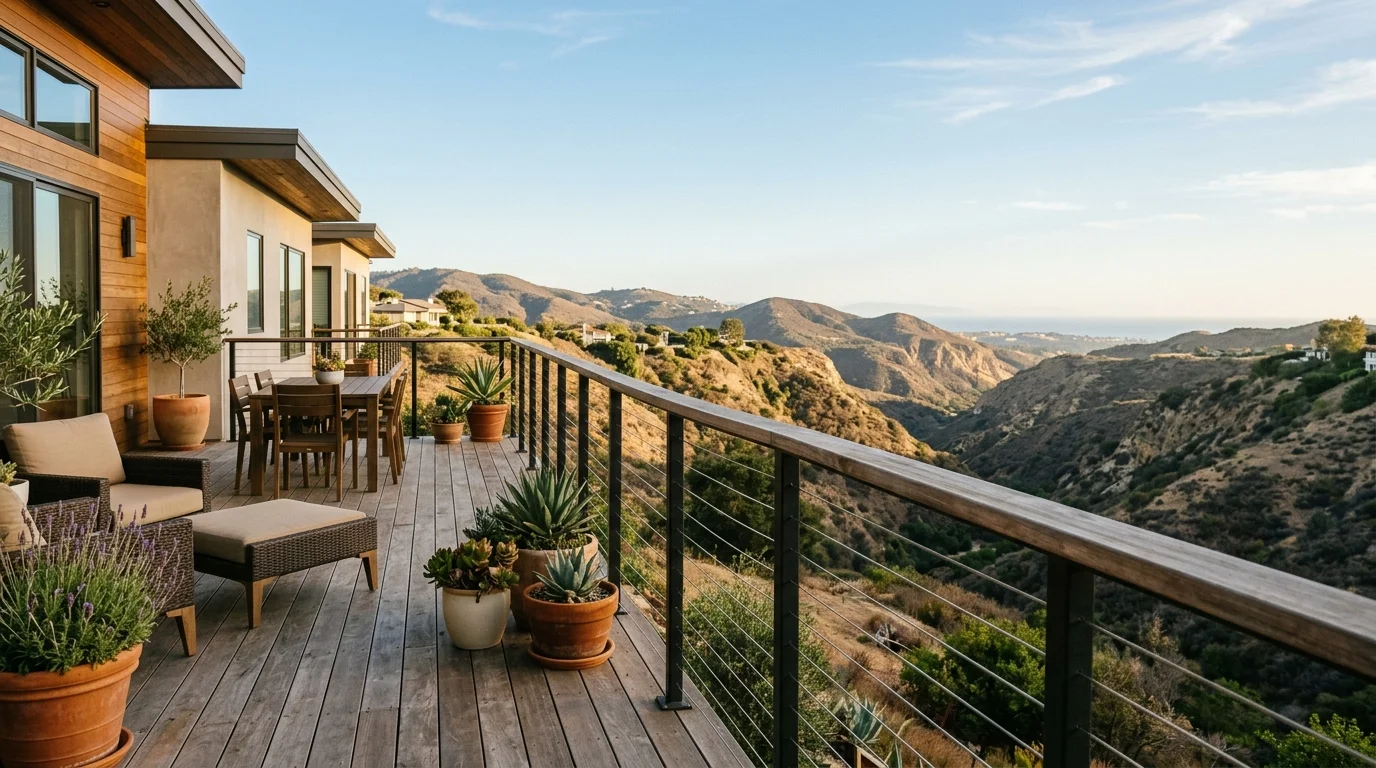
Why canyon, hillside, and coastal lots ask for cable instead of wood balusters
People buy lots in Mission Hills, Mount Soledad, and the drops off I-8 because the grade is the amenity. Sit down behind wood balusters and the view collapses into stripes. Slim metal balusters do it too. They stack. Cable infill stays thin enough that the canyon, the harbor, or the night grid stays in the picture.
Coastal north county is not East County. In Del Mar, Solana Beach, and Encinitas the view is water and bluff. Del Mar’s housing stock is older than most of the county: 69.4% of homes were built before 1978, so a lot of those bluff decks still wear original closed wood rails. Inland, El Cajon, Alpine, and the Ramona grade often look at a hillside or a valley. Cable shows up there too. The point is the drop, not the surf.
Cable is also common on multi-level decks that step down a slope in Tierrasanta, Scripps Ranch, or Fallbrook. Each landing still needs a guard once the walking surface sits more than 30 inches above the grade below, measured at any point within 36 inches of the edge. That 30-inch trigger is California Residential Code. It catches a lot of “low” hillside platforms people assume are exempt.
None of that makes cable a style-only choice. It is still a guard. In California the top of that guard has to be at least 42 inches above the walking surface. National product sheets often show 36 inches. That figure is wrong here.
If you are taking out an old wood rail on a view lot, start with the deck railings scope, not a hardware kit. Posts, top rail, and how the assembly ties into the framing matter more than the shine of the cable. The pros we connect you with are licensed and insured. They size the rail to the deck, not the other way around.
Horizontal vs vertical cable, and why opening limits are a local code call
Horizontal cable is what most San Diego view decks want. The lines run with the horizon, so your eye skips them. Vertical cable still opens the view. It reads more like a screen than a vanished edge.
The legal question is not whether cable is allowed. A cable guard is allowed when the finished assembly meets the same rules as any other guard: height, openings, and load. California requires guards at least 42 inches high on decks. Openings from the walking surface to that required height cannot let a 4-inch sphere pass. On the open side of stairs the sphere is 4-3/8 inches. The stair guard itself can be 34 inches, measured from a line connecting the tread nosings.
Horizontal cable gets sticky because it flexes. Cables can be pushed apart, especially by kids, if they are slack or laid out so a 4-inch sphere fits when they spread. Some building departments treat that as a reason to prefer vertical cable, a tighter layout, or a different infill. That is a local call. Inside the City of San Diego, permits and plan review go through Development Services. Unincorporated county lots go to the county, not the city. Encinitas, Chula Vista, Oceanside, and the rest each run their own counter.
Do not guess cable diameter or a “standard” gap from a box. Those numbers are not a substitute for the sphere test on the installed rail. Confirm the current reading with the jurisdiction that will inspect the address.
Stairs add a second system. A flight with four or more risers needs a graspable handrail on at least one side, 34 to 38 inches above the nosings, with a profile you can actually hold. Cable infill is not that handrail. The deck railings code requirements walk through height, openings, and when a handrail is required. The independent crew matched to the job pulls the permit in its own name and schedules the inspections.
Posts, bay spacing, and why a wide run sags if it is under-built
Cable only looks light. The load still hits the posts and the framing. Guards and handrails have to take a 200-pound concentrated load in any direction at any point along the top. Infill has to take 50 pounds on one square foot. A wide bay with skinny posts and a decorative top rail will sag. Then it fails inspection. Then it keeps sagging after you live with it.
Sag is the tell. If a run looks like a hammock between posts, the bay is too wide, the posts are too soft, the terminators are slipping, or the cables were never brought to a stable tension. A Point Loma second story in a westerly, and kids leaning on a Mission Valley deck, both find the weak bay first.
There is no single publishable post spacing that applies to every San Diego address. Post size, material, surface vs fascia mount, whether the top rail is structural, and the cable hardware all change the answer. The matched pro sizes the posts to the run and to the load path into the deck framing. On a hillside build, that path often goes through the same structure that holds the deck over the drop. The rail is not an afterthought bolted to a rim that was never meant to take it.
Corners, gates, and stair transitions are where kit jobs usually come apart. Each change of direction needs a post that can take tension from more than one way. A long open run with one undersized post in the middle will show droop. So will a fascia mount on tired rim joists. If the deck itself is moving, no amount of cranking the fittings will hold a straight line.
Stainless cable in salt air vs coated cable inland
Salt air along Imperial Beach, Coronado, Ocean Beach, and La Jolla is not the same climate as Ramona or Escondido. Stainless cable is the usual coastal spec because iron and cheap plated fittings stain and pit. Inland, some crews still use stainless. Some use coated cable on a powder-coated frame because the salt load is lower and the look is meant to match the house.
Do not treat “stainless” as one material. Finish, hardware, and how fittings are sealed at the post matter as much as the wire. A coastal install that mixes stainless cable with non-stainless screws will rust at the junction first. Ask the matched pro what they specify for marine exposure on that address, and get it in the quote. Confirm the contractor on the CSLB license lookup before you sign.
Coated cable can look cleaner inland, then chalk, peel, or trap moisture at the ends. East County sun is hard on coatings. Backcountry lots add dust. None of that is a reason to skip stainless on the coast.
Irrigation overspray is a quiet killer in Mission Valley and the South Bay. Keep sprinklers off the posts. Chlorides from the ocean already sit on a coastal rail. Bleach and some household cleaners leave more chlorides behind. The crew should leave a care sheet that matches the hardware they installed. If they cannot name the alloy and the fitting series, keep looking.
Cleaning, tensioning, and fray: the maintenance nobody shows in the catalog
Product shots show cables like guitar strings. They do not show the later tension check. Cable stretches. Hardware beds in. A cool marine morning in Pacific Beach and a hot afternoon in El Cajon both move the metal.
Tensioning is maintenance, not a defect, if it is occasional and small. If you are cranking fittings constantly, a post is moving, a terminator is slipping, or the original install was short of tension. Fray at a fitting or a sharp post hole is different. Broken wires mean that cable is done. Do not wrap it in tape and wait.
Cleaning is simple and easy to skip. Rinse salt. Wipe fittings. South Bay and coastal north county decks that never get a hose will show tea staining on stainless long before an inland rail does. Tea staining looks like rust. It is often surface. It is also the warning that salt is sitting in the lay of the cable.
Pets and kids will treat horizontal cable like a ladder. That is a use problem as much as a code problem. If the household needs a climb-resistant guard, say so before shop drawings. Vertical cable, glass, or a tighter metal infill may be the better guard even if the view is slightly busier.
Deck Pro SD does not set prices, and there is no single county figure for this work. Run length, post count, stair work, fascia vs surface mount, and coastal hardware all change the quote. Ask the matched pro for the assembly, the load path, and who pulls the permit.
When cable is the wrong guard, and how it compares with glass and metal
Cable is the wrong guard when you need a wind break, privacy, or a climb-resistant infill. It is also the wrong guard when the HOA bans horizontal infill, or when the inspector at that address will not accept flexible cable under the 4-inch sphere test. Pool barriers follow their own rules, separate from a deck guard. Confirm those with the building department that covers the lot. Do not assume a deck cable layout transfers.
Glass deck railings keep the view and stop wind. They also show salt film, need different posts, and change how a hillside deck feels in a westerly. Custom metal handrails cover balusters, rods, and fabricated guards that do not rely on tension. Metal can stay visually quiet without the sag-and-tune cycle of cable. It can also read busy. That is the trade.
A licensed deck builder is the right call when the rail is a required guard, when the walking surface is more than 30 inches up, or when you are opening a pony wall to steal a view. Deck Pro SD is a referral service. It matches you with independent local pros. It does not install the rail, own the hardware, or hold the permit.
When to call us
If a view lot needs a new guard, a pony-wall tear-out, or a stair rail that has to pass inspection, that is licensed deck work. The pros we connect you with are licensed and insured. Call us at (858) 400-4918, leave a message, and we’ll connect you with a licensed local deck builder.