For custom handrails in Poway or El Cajon, start with the stair geometry, not a catalog photo. The right design must fit the site, provide a graspable surface, and meet California height rules. Material and finish choices come after those requirements. Census ACS data puts 62.5% of El Cajon housing before 1978, so existing stringers and mounting points often need a look before anyone orders ornamental metal.
A search for custom handrails in El Cajon is mostly fence, gate, and iron-shop results. A deck stair handrail is a graspable code piece on a stair or guard. It is not a driveway gate. Ask the fabricator to label the graspable handrail separately from any ornamental infill.
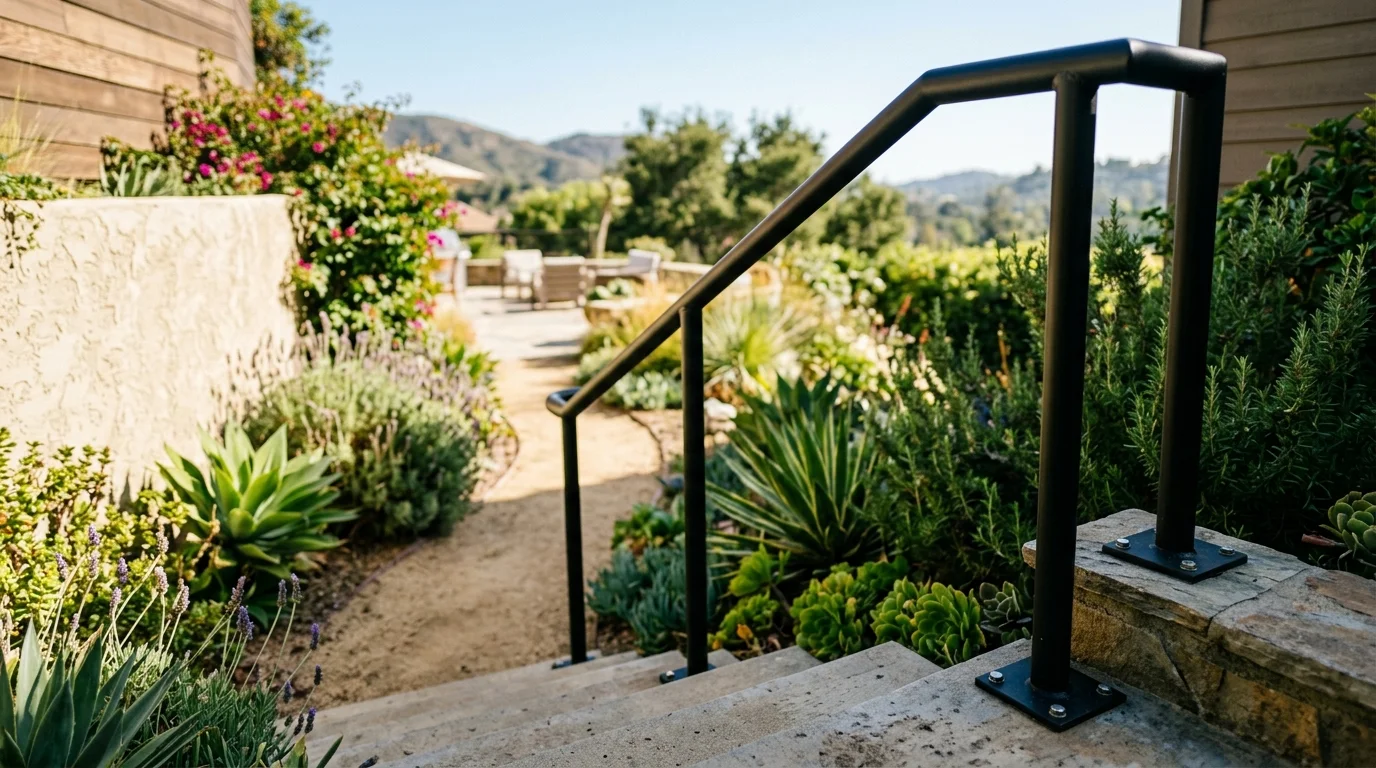
When a stock railing isn’t a clean fit
A stock kit works from preset dimensions and connection details. Custom fabrication lets the design begin with measurements from the actual stairs, landing, or deck edge. That distinction matters when the layout includes turns, uneven transitions, existing posts, or an ornamental pattern.
Poway also has a mixed housing history. U.S. Census Bureau data shows 49.2% of its homes were built before 1978. That figure doesn’t reveal the condition of any particular stair or deck. It does support checking existing construction before selecting a rail system.
Start by deciding what problem the railing must solve. A stair may need a continuous graspable handrail. An elevated deck edge may need a guard. One assembly can sometimes include both features, but the applicable dimensions differ. Our guides to deck stairs and deck railings explain those scopes in more detail.
Custom work is also useful when appearance matters at a visible entry. The fabricator can prepare a design around the actual run, mounting points, and desired pattern. Ornamental elements still can’t interfere with required height, openings, or graspability.
Homeowners comparing options in Poway can start with the local deck builder referral page. Homeowners in El Cajon can start with the El Cajon deck builder page. Deck Pro SD doesn’t fabricate or install railings. We match homeowners with licensed, insured independent professionals who handle the physical work.
Compare metals through written specifications
Mild steel, aluminum, and stainless steel shouldn’t be compared by name alone. Ask each fabricator to identify the exact material, finish system, fasteners, mounting method, and maintenance instructions in writing. That creates a useful comparison between proposals.
No current, source-backed countywide price range could be confirmed for custom metal handrails. A blanket claim that one metal always costs a certain amount would ignore design, fabrication, finish, access, and attachment details. Compare itemized bids for the same measured scope instead.
For mild steel, request the coating specification and preparation steps. For powder-coated aluminum, request the powder manufacturer’s current technical documents. For stainless, ask for the stated alloy and the fabricator’s care instructions. Don’t treat a general material label as proof of performance.
Location should be part of that conversation. A Poway or El Cajon project shouldn’t automatically receive the same recommendation as every other San Diego County address. Ask the fabricator to explain why the proposed metal, coating, and fasteners suit the specific site. Request documentation for any corrosion-resistance or service-life claim.
The quote should also identify what happens at welds, cuts, mounting plates, and fastener connections. Those details help you compare full assemblies rather than showroom samples. If the design connects to an existing deck, have the licensed pro assess that supporting area before fabrication begins.
Deck Pro SD doesn’t set prices or provide warranties. Any price, workmanship warranty, or product warranty comes from the independent professional or manufacturer. Read those terms before accepting the design.
Field measurements should control fabrication
Treat plan dimensions as a starting point. Before approving fabrication, require measurements from the completed or existing site. The fabricator should record the stair run, riser layout, landing edges, post locations, wall clearance, and available mounting surfaces.
Ask how those measurements become shop drawings or a physical template. The approval drawing should show the overall rail path and its attachment points. It should also separate the graspable handrail from any guard or decorative infill. That makes code review much clearer.
Don’t approve a drawing that leaves important dimensions unstated. Handrail height, guard height, wall clearance, and opening sizes should be visible where they apply. For stairs, confirm that measurements follow the tread nosings rather than an unrelated floor line.
Existing construction deserves its own review. A custom rail can fit a stair perfectly while the proposed mounting area still needs attention. Ask the licensed professional to examine the deck framing, stair stringers, landing, and other attachment points included in the project. Don’t assume a mounting plate or decorative cover answers a structural question.
Site changes after measurement also need a clear process. Ask who must approve revised dimensions and whether fabrication pauses until that approval occurs. Put the final material, profile, finish, and mounting details on the same approved drawing.
If permitted work is required, the independent crew matched to the job pulls the permit in its own name and schedules inspections. Deck Pro SD doesn’t file permits. Whether your handrail project needs a permit depends on the scope, so confirm it with the building department responsible for the property before anything is fabricated.
Decorative rails still follow California dimensions
California’s residential rules give several dimensions that affect custom work. A handrail is required on at least one side of a continuous stair run with four or more risers. Its top must sit 34 to 38 inches above the tread nosings.
A wall-mounted handrail needs at least 1 1/2 inches of space from the wall. Its ends must return or terminate in newel posts or safety terminals. These details should appear on the fabricator’s drawing, especially where the rail meets a wall or landing.
The graspable profile also matters. A circular Type I handrail must measure from 1 1/4 to 2 inches in diameter. A noncircular Type I profile needs a perimeter of at least 4 inches. Type II profiles with a perimeter above 6 1/4 inches require graspable finger recesses on both sides. The width above those recesses must be 1 1/4 to 2 3/4 inches.
That’s why a broad ornamental top rail may not answer the handrail requirement. Ask the designer to label the graspable portion clearly. Our San Diego deck stair code guide covers the related stair dimensions.
Guards follow another set of rules. They’re required along open walking surfaces more than 30 inches above the floor or grade below, measured within 36 inches horizontally from the edge. California residential guards must be at least 42 inches high. Guards on open stair sides must be at least 34 inches above the line connecting the tread edges.
Guard openings generally can’t allow a 4-inch sphere to pass. Open stair guards use a 4 3/8-inch limit. The California requirements also address concentrated loads on handrails, guards, balusters, and panel fillers. Read the related deck railing code guide before approving ornamental spacing.
Treat rust-through as more than a finish choice
Visible rust-through should trigger a condition question, not only a color decision. Ask the licensed professional whether the affected rail or supporting connection remains suitable. Don’t authorize a coating-only scope until that assessment is complete.
No universal finish lifespan could be confirmed for Poway, El Cajon, or San Diego County. Manufacturer warranties also vary by product and terms. Ask for the current technical data and warranty documents tied to the exact coating or material being proposed.
For a powder-coated assembly, request the full finish specification. It should identify the preparation process, powder product, color, sheen, and treatment of welds and cut areas. If the fabricator proposes work over existing metal, ask how the existing condition changes that specification.
The same discipline applies to aluminum and stainless proposals. Request exact material descriptions rather than accepting a broad label. Ask whether the fasteners, anchors, mounting plates, and decorative pieces use the same material. If not, require the fabricator to explain the combination in writing.
Maintenance instructions should arrive before installation. Ask what cleaning products the manufacturer permits, what conditions require inspection, and how damage should be handled. Keep those instructions with the approved drawing and product documents.
A finish sample can help with color and texture, but it doesn’t replace the written system. Compare proposals using the complete assembly. That includes the base metal, preparation, finish, fasteners, anchors, and mounting details. If a seller promises a specific service life, request the document supporting that promise.
Questions to settle before approving the design
A good proposal should answer more than style and color. Use the same questions with every fabricator so the differences stay visible.
- What exact metal, profile, fasteners, and finish are included?
- Which field measurements control the shop drawing?
- Where are the handrail, guard, and ornamental portions labeled?
- How does the design address required height, graspability, and openings?
- What existing framing or mounting surfaces need assessment?
- Who handles revisions if site dimensions change?
- Is a permit required for this exact Poway scope?
- Which party pulls any required permit and schedules inspections?
- What manufacturer documents apply to the proposed finish?
- What workmanship or product warranty terms are written into the contract?
- What maintenance instructions come with the completed assembly?
- What is included in the quoted scope, and what remains excluded?
Verify the professional before signing. The California Contractors State License Board lookup lets you check the license information provided by a contractor. Confirm that the contract names the party performing the work.
Ask for the final drawing before metal is cut. It should reflect field measurements and identify the approved finish. Keep the drawing, specifications, warranty documents, and maintenance instructions together.
Deck Pro SD is the referral service, not the fabricator. We don’t perform measurements, make railings, install hardware, set prices, or provide warranties. The independent professional you hire handles the project and contracts with you directly.
When to call us
Call when a custom handrail involves deck framing, exterior stairs, guards, or mounting details that need a licensed Deck Building professional. Deck Pro SD can match you with an independent local pro who can review the site and proposed scope.
Call us at (858) 400-4918, leave a message, and we’ll connect you with a licensed local deck builder.