If you want the view, glass can be the right San Diego guard. If you will not clean salt film and fingerprints, the live deck will not look like the catalog photo. Searching for glass deck railings near me in San Diego means comparing sightlines, hardware, cleaning, glare, permits, and California’s 42-inch residential guard rule, not only clear panels.
Start with the view you want to keep
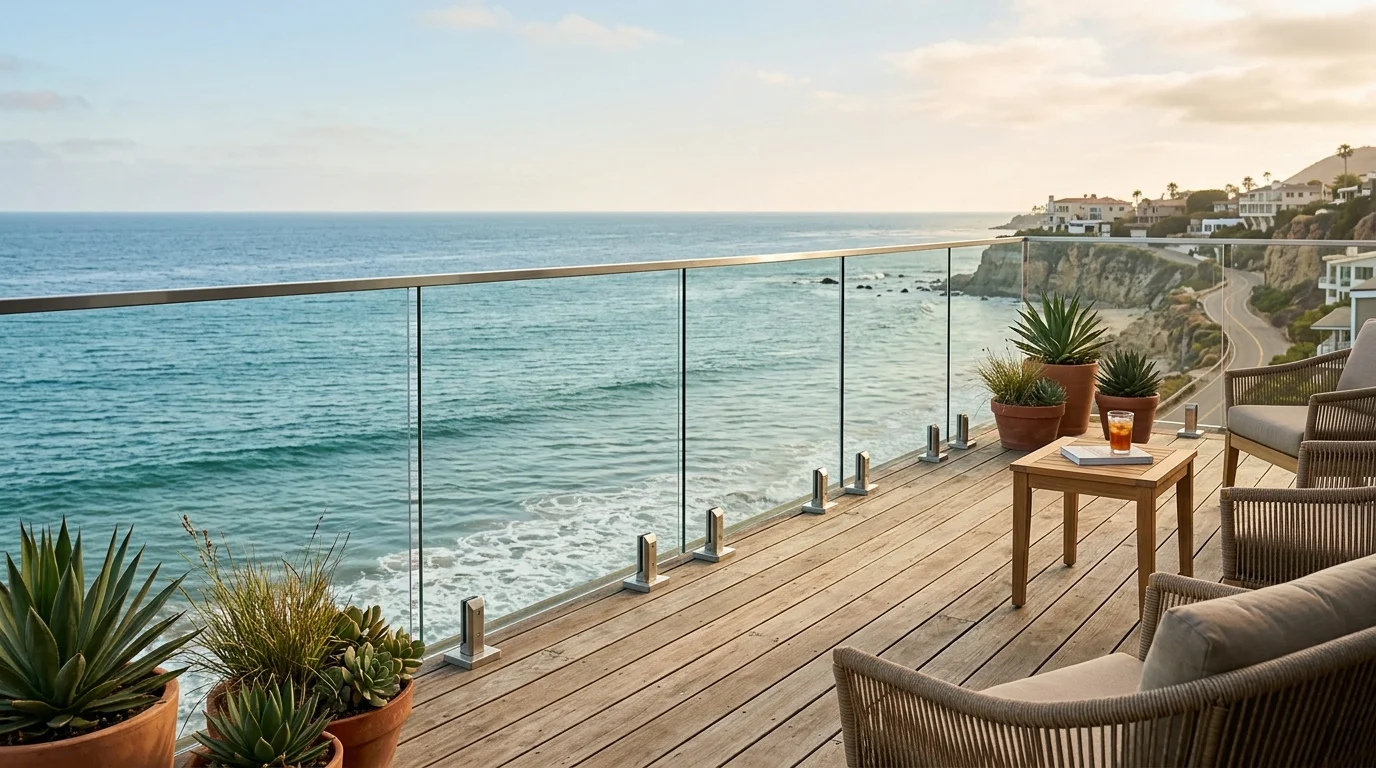
Glass makes the strongest case when the view drives the project. An ocean-facing, canyon-facing, or hillside deck can lose much of its appeal behind closely spaced vertical rails. Clear panels reduce that visual interruption.
No railing is literally invisible. Posts, panel edges, gates, corners, and top rails can still cross an important sightline. Compare layouts from the places where people will sit and stand. A drawing viewed from above won’t reveal what lands directly across the horizon.
Photograph the view from several positions before meeting a builder. Mark the areas that matter most. The builder can then discuss post locations, panel widths, corners, and transitions without guessing what “unobstructed” means to you.
This matters on narrow balconies as much as large decks. A compact space may have only one useful viewing angle. Wider decks can have several, including seated views that fall below the standing eye line.
Coastal location alone doesn’t settle the decision. A glass guard facing a neighboring wall delivers a different result from one facing open water. Homeowners planning a project near the North County coast can start with our Encinitas deck builder referral page.
Treat the view as a design requirement. Show the builder exactly where the railing should feel quiet. That gives each proposal a clear target.
Compare the system, not the label
Framed, semi-frameless, and frameless are useful starting terms. They aren’t enough to compare two proposals. Each builder should provide a drawing showing every post, rail, panel edge, gate, and connection.
A framed proposal should identify the frame surrounding or supporting the panels. A semi-frameless proposal should show which frame elements remain. A frameless proposal should reveal the base or point connections holding each panel. The drawing matters more than the sales label.
Count the visible hardware. Then count the places that will need cleaning. A low-profile connection may protect a sightline but leave different access around the panel base. A top rail creates another visible line. Corners and stairs can introduce hardware that isn’t obvious in a showroom sample.
No current San Diego market price range for these three system types could be confirmed. The independent builder and product supplier set the actual quote. Ask for an itemized proposal rather than assuming “frameless” has one fixed price.
The proposal should separate the railing from related work. Ask whether it covers removal, deck-edge repairs, stairs, gates, finishes, and permit work. If the existing deck edge can’t accept the selected system, the builder should identify that before installation begins.
Our deck railing service explains how referrals work. Deck Pro SD doesn’t sell railing systems, set construction prices, or perform installation. We match homeowners with licensed and insured independent local pros. You contract with the selected professional directly.
Let the tested assembly determine the glass
Tempered and laminated glass shouldn’t be treated as interchangeable shopping labels. Manufacturer paperwork should identify whether a product uses heat-treated tempered glass or a laminated assembly made from bonded layers.
Those descriptions don’t establish whether a complete railing system fits your deck. They also don’t produce one universal panel thickness. The correct glass makeup and thickness couldn’t be confirmed as a single countywide specification. The selected assembly, its supporting hardware, and its product documentation control that decision.
California guard loads provide the performance target. Guards and handrails must withstand a concentrated load of 200 pounds applied in any direction along the top. Guard infill and panel fillers must withstand a horizontal load of 50 pounds over one square foot. Those figures don’t tell a homeowner to choose a particular thickness from a catalog.
Ask the builder to connect each proposed panel to the documentation for the complete system. The paperwork should identify the glass, hardware, supports, installation method, and permitted configuration. A standalone panel description doesn’t answer how the finished guard carries its required loads.
If a proposal says tempered glass, ask where that specification appears. If it says laminated glass, ask for the layer and interlayer description from the manufacturer. If two builders suggest different thicknesses, ask each one to show why its complete system calls for that choice.
This keeps the decision tied to documented performance. It also prevents a familiar mistake: comparing panel thickness while ignoring the hardware that supports it.
California guard rules still control the design
A clear panel doesn’t replace the requirements for a residential guard. California rules require guards along open deck edges more than 30 inches above the floor or grade below. That measurement considers points within 36 inches horizontally from the open edge.
Required residential guards must be at least 42 inches high above the walking surface. Guards along open stair sides must be at least 34 inches high, measured from the line connecting the tread edges.
Openings also matter. A residential guard can’t allow a 4-inch-diameter sphere to pass through its openings. The limit along open stair sides is 4 3/8 inches. With glass, panel placement and gaps around the edges remain part of that review.
The complete system must also satisfy the guard-load requirements. A panel can serve as infill only when its installed assembly meets the applicable requirements. Transparency doesn’t reduce the structural duty of the guard.
Our guide to San Diego deck railing code requirements gives homeowners a closer look at these measurements. The builder should still verify the current rules for the property and proposed design.
For property inside the City of San Diego, confirm current permit direction with Development Services. Other cities and unincorporated areas can have different reviewing authorities. A countywide permit answer for every glass railing project couldn’t be confirmed.
When a permit is required, the independent crew matched to the project pulls it in its own name and schedules inspections. Deck Pro SD doesn’t file permits or perform construction.
Plan for salt residue and water spots
Showroom glass and outdoor glass live different lives. Before choosing a system, think about what already lands on windows, doors, and furniture around your deck.
Salt residue and hard-water spotting are common concerns raised by coastal homeowners. Their severity and cleaning frequency can’t be reduced to one San Diego schedule. Distance from open water, sprinkler placement, irrigation overspray, panel orientation, and the selected product all belong in the site discussion.
Look closely at access. Can both faces of every panel be reached without leaning beyond the deck edge? Are panel bases easy to wipe? Will a corner, planter, stair, or built-in bench block part of the glass? The prettiest drawing may hide an awkward cleaning position.
Ask the product manufacturer for its current cleaning instructions. Request the approved cleaner types, tools, and treatment guidance in writing. Don’t assume a coating is included because a sample looks unusually clear. The proposal should name every selected finish or treatment.
Hard-water exposure deserves attention before installation. Check the path of nearby sprinklers and hose use. Moving overspray away from the railing may be more practical than repeatedly treating visible spots.
Hardware needs the same product-specific review. Ask the builder to identify each exposed component and provide its care instructions. Don’t infer suitability from appearance alone.
Our guide to decking for coastal salt air covers the broader material conversation. The railing and deck surface should be reviewed together, even when different manufacturers supply them.
Know when glass is the wrong fit
Glass isn’t the automatic answer for every exposed edge. The view may not justify the cleaning access, hardware layout, or site-specific concerns.
Pool areas require separate attention. Don’t assume a deck guard automatically satisfies every rule for a pool enclosure. One countywide answer for all San Diego jurisdictions is not published in a source we can verify. Ask the authority reviewing the property whether the proposed barrier, gate, openings, and hardware meet its current requirements.
West-facing glare is another site question. Visit the deck when the sun reaches the railing face. Stand where people usually sit. If reflected light already causes discomfort on nearby windows, ask to see a full-size panel sample in that location. A small indoor sample won’t recreate the same viewing position.
Wind exposure also needs a project-specific review. Don’t choose a panel or connection from a generic wind description for the neighborhood. The independent builder should select the system from the actual deck location, height, framing, and manufacturer documentation.
These questions matter on elevated structures. Our rooftop and balcony deck service covers referrals for projects where railing work connects with a larger deck scope. An existing deck edge may need evaluation before any new guard system is selected.
Compare glass against the problem you’re solving. If the view is modest and cleaning access is poor, another railing layout may be the better choice. If preserving a specific sightline matters, glass may earn its added planning.
Before hiring, confirm the professional’s license through the CSLB license check. Then make sure the written proposal identifies the exact railing system and responsibility for permits.
When to call us
Glass railing work needs a licensed deck builder when it affects a required guard, deck-edge framing, stairs, gates, or permit scope. Call us at (858) 400-4918, leave a message, and we’ll connect you with a licensed local deck builder.