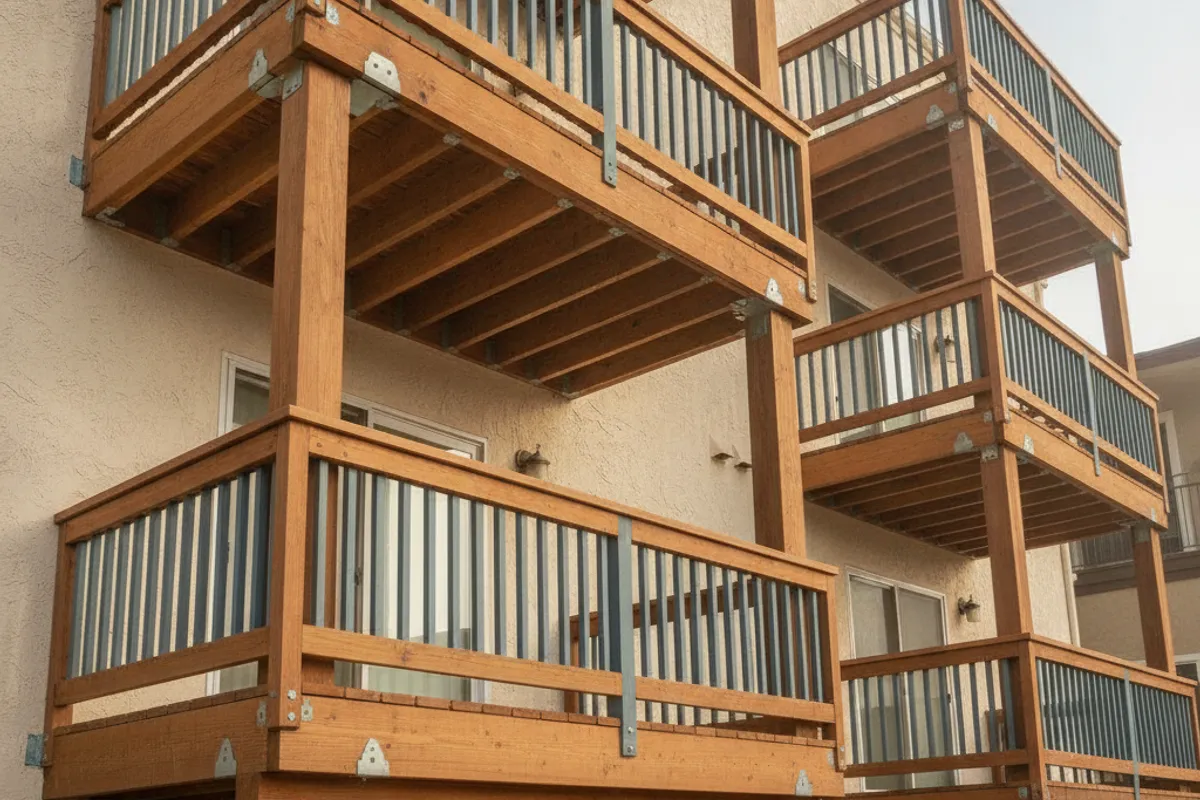
The statutes that people mean by California balcony inspection law are Health and Safety Code 17973 (SB 721) and Civil Code 5551 (SB 326). They apply to named multifamily buildings with three or more units. A typical single-family house is outside those inspection cycles. Deck Pro SD does not perform the statutory inspection. If a report flags repair, we match you with an independent licensed crew.
SB 721 required apartment owners to complete the first exterior elevated element inspection by January 1, 2026. If you own an apartment building in San Diego and missed that date, the building is out of that inspection cycle until you complete it. Schedule a qualified inspector from the list the statute names. That is not a Deck Pro SD service.
SB 721 versus SB 326
People often conflate the two state inspection rules. The split depends entirely on the ownership structure of your building. SB 721 applies to apartment buildings. SB 326 applies to condominiums and homeowners associations. The deadlines and inspection intervals genuinely differ between the two laws.
| Requirement | SB 721 (Apartments) | SB 326 (Condos and HOAs) |
|---|---|---|
| Building type | Three or more multifamily units | Three or more attached multifamily units |
| First deadline | January 1, 2026 | January 1, 2025 |
| Inspection interval | Every six years | Every nine years |
These rules apply across the state. A building in Pacific Beach follows the same timeline as a complex in El Cajon. The law requires strict adherence to these intervals. After the initial January 1, 2026 deadline, apartment owners must complete subsequent inspections by January 1 every six years thereafter. Condo associations had an earlier deadline of January 1, 2025. They must complete their follow-up inspections every nine years thereafter.
What counts as an exterior elevated element
The law defines these elements specifically to target structures that pose a fall risk. They include balconies, decks, porches, stairways, walkways and entry structures.
To fall under the mandate, the element must extend beyond the exterior walls of the building. It must have a walking surface elevated more than six feet above ground level. It must be designed for human occupancy or use. It must also rely in whole or in substantial part on wood or wood-based products.
This last point answers a common question from property owners. A concrete balcony supported entirely by a steel frame doesn’t meet the wood requirement. If the load-bearing components use wood, the structure requires inspection. The law focuses on wood because it decays when exposed to the elements.
Who is legally allowed to perform the inspection
You can’t hire a standard handyman to check off this legal requirement. The two statutes name different lists of qualified professionals. Hiring the wrong person means paying for an invalid inspection.
For apartments under SB 721, you can hire a licensed architect or a licensed civil or structural engineer. You can also hire a certified building inspector. They must hold certification from a recognized state, national or international association. You can also use a qualified building contractor. They must hold an A, B or C-5 license classification. They also need a minimum of five years of experience.
Condos and HOAs under SB 326 have a stricter list. California Civil Code 5551 requires a licensed structural or civil engineer or architect. They must inspect the load-bearing components together with their associated waterproofing system. A general contractor cannot perform the SB 326 inspection for a condo building.
What happens when an inspector finds an immediate threat
Sometimes an inspection uncovers severe structural decay that threatens collapse. An inspector might advise that an exterior elevated element poses an immediate threat to occupant safety. The law classifies this as an emergency condition. Under the statute, the building owner must perform the required preventive measures immediately.
You can’t wait to fix a dangerous balcony. The statute places an immediate obligation on the owner to address the hazard.
San Diego weather and balcony wear
Multifamily buildings face unique environmental stress in San Diego County. Coastal salt air in towns like Carlsbad and Oceanside constantly attacks exterior wood structures. Heavy marine-layer moisture penetrates deep into the wood grain. This moisture targets the ledger connection and the waterproofing membrane.
These are exactly the points where elevated elements fail. Regular inspections catch this rot before a balcony becomes an emergency condition. We see many deck dry rot and ledger board repairs in San Diego caused by this exact coastal weather pattern.
Repair costs and timeframes for failed inspections
If your inspection report flags structural damage, you must repair it. Targeted deck repairs for a ledger, joists, or post base run $500 to $8,000 depending on the scope. A full structural repair or rebuild of the affected section runs $8,000 to $25,000.
Most standard repairs finish in one to five days. Full structural rebuilds take one to three weeks. You also need to consider local building codes. Like-for-like board replacement usually doesn’t require a permit in San Diego. Replacing structural members like ledger boards or joists often does. This is especially true if the repair changes the loading or configuration. The crew checks before quoting and pulls the structural permit when required.
How Deck Pro SD fits into the process
Deck Pro SD doesn’t perform SB 721 or SB 326 inspections. We don’t employ inspectors. The statutory inspection itself must be performed by one of the qualified professionals the statute names.
We’re a referral service. When your inspection report flags dry rot or structural damage, we step in. Deck Pro SD matches property owners with independent licensed professionals. The pros we connect you with handle the deck repair and restoration work required to bring your building back into compliance. Call us at (858) 400-4918 to find a local crew for your repair project.
Frequently asked questions
Does a concrete balcony require an SB 721 inspection?
It doesn’t require inspection if it lacks wood components. The law specifically targets exterior elevated elements that rely in whole or in substantial part on wood or wood-based products. A concrete balcony supported entirely by a steel frame is exempt.
Who can inspect my San Diego apartment building?
You can hire a licensed architect, a licensed civil or structural engineer, or a certified building inspector. You can also use a building contractor holding an A, B or C-5 license classification with a minimum of five years of experience. The law strictly limits who can perform this work.
When was the first balcony inspection deadline?
The first inspection deadline for apartments under SB 721 was January 1, 2026. Condos and HOAs governed by SB 326 had an earlier deadline of January 1, 2025. If you missed these dates, your building is currently out of compliance.
How often must I schedule balcony inspections?
Apartment owners must complete an inspection every six years following their initial deadline. Condos and HOAs must perform their subsequent inspections every nine years. You must maintain this schedule to stay compliant with state law.
Does balcony repair require a permit in San Diego?
Replacing structural members like ledger boards, joists, beams, and posts often requires a permit. This is especially true if the repair changes the loading or configuration. Like-for-like board replacement usually doesn’t require a permit in San Diego.