Figuring out how to repair splintered wood deck boards usually starts with a sander. You rarely need a crowbar right away. Splintering is typically surface weathering you can fix without replacing the boards. There’s one simple test that tells you when the damage goes deeper.
Why deck boards splinter in San Diego
Wood splinters when ultraviolet light breaks down the lignin at the surface. Then wet and dry cycles raise the grain. In San Diego, that cycle is highly specific. Coastal neighborhoods get heavy marine layer mornings that soak the deck surface. Strong afternoon sun then dries the wood rapidly. That daily swing is much harder on a finish than steady weather. Inland in East County, the primary enemies are intense UV exposure and high heat. Both climates eventually cause the wood fibers to separate and splinter.
The screwdriver test for deck boards
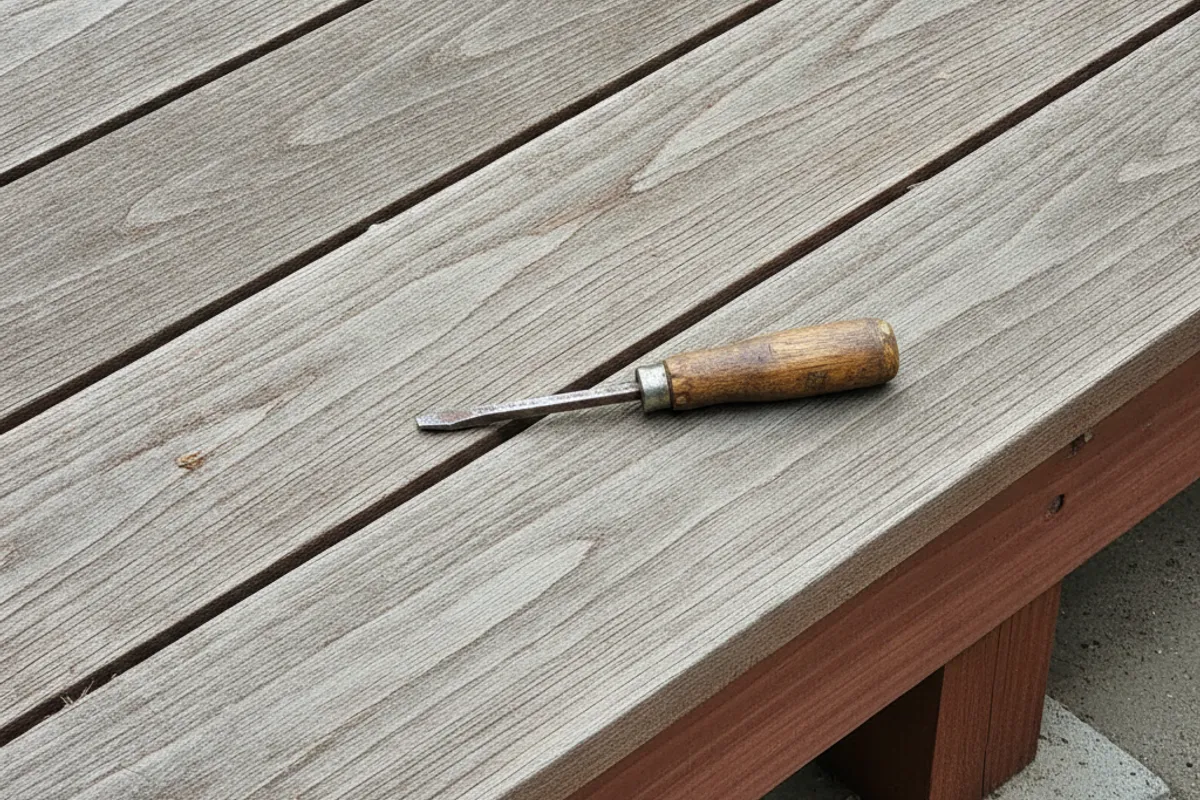
Before you plan a sanding weekend, you need to probe the wood. Take a flathead screwdriver and press it into the splintered areas. If the wood is firm and the screwdriver bounces off, you have surface splintering over sound wood. That’s refinishing work. If the wood feels soft or spongy and the screwdriver sinks in, you have rot. Rotted wood can’t be sanded or saved. It has to be replaced. If you find soft wood at the ledger board or a post base, you have a structural problem rather than a cosmetic one. You can read our guide on deck dry rot and ledger board repair to understand those structural fixes.
What deck refinishing actually involves
Refinishing a splintered deck requires cleaning, sanding, and sealing. A heavy wash removes dirt and loose fibers. Then a floor sander knocks the raised grain back to a smooth surface. Finally, a new coat of sealer locks out the moisture. Sanding has limits. If your deck boards are cupping heavily or checking with deep cracks, a sander can only do so much. Sanding a badly cupped board just flattens the middle while leaving the edges rough. At that point, refinishing might not deliver the smooth surface you want. Our deck staining and refinishing guide covers the prep process in detail.
When to replace individual deck boards
Sometimes a single board splinters badly while the rest of the deck stays smooth. You can remove that single board and drop in a replacement. This solves the splinter hazard quickly. The tradeoff is appearance. Replacing a few boards on an older deck leaves a color mismatch. New wood accepts stain differently than weathered wood. Even with a solid color stain, the new boards stand out from the surrounding deck for years. The colors rarely even out completely.
Resurfacing over sound framing
When too many boards are splintering or cupping, full resurfacing is often the best choice. This is the honest middle option between a patch job and a total rebuild. If your posts, joists, and ledger board are still solid, the crew removes the old surface boards. They then install entirely new decking over the existing frame. This gives you a brand new walking surface without the cost of a full structural rebuild. You can learn more about this on our deck resurfacing page.
Knowing when the finish is due again
A fresh finish prevents splintering, but it doesn’t last forever, and the deck tells you when it’s due rather than the calendar. Watch for water that soaks straight in instead of beading on the surface, color going flat and grey in the traffic lanes, and the first roughness under a bare hand. Those three signals show up long before the grain lifts far enough to splinter.
Exposure drives how fast you get there. A coastal deck cycling wet and dry every morning works through a finish faster than an inland deck with afternoon shade, and a west-facing surface in full sun faster than either. The crew that builds or resurfaces your deck can tell you the realistic cycle for your exposure and the product they used, which is a more useful answer than a number that ignores both.
Deck repair costs and permits
Targeted deck repairs run $500 to $8,000 depending on the scope of the damage. A full structural repair or rebuild of the affected section runs $8,000 to $25,000. Most repairs finish in one to five days. Structural rebuilds take one to three weeks. Like-for-like board replacement usually doesn’t require a permit in San Diego. Replacing structural members like ledger boards, joists, beams, or posts often does. This is especially true if the repair changes the loading or configuration. The pros we connect you with check the requirements before quoting and pull the permit when required.
Frequently asked questions
Can you sand out deep deck splinters?
Surface splinters sand out easily with standard floor sanders. Deep structural splits or heavy checking can’t be sanded away. If the crack goes more than halfway through the board, replacement is the safer choice.
Do I need a permit to replace splintered deck boards in San Diego?
Like-for-like board replacement usually doesn’t require a permit in San Diego. If the damage extends to structural members like joists or posts, a permit is often required.
Why do deck boards splinter so fast near the coast?
Coastal decks experience intense wet and dry cycles. Heavy morning marine layers soak the wood, and strong afternoon sun dries it rapidly. This constant expansion and contraction breaks down the wood fibers.
How long does deck repair take?
Most targeted deck repairs finish in one to five days. Full structural rebuilds of affected sections take one to three weeks to complete.
Get help with your splintering deck
You don’t have to spend your weekend behind a heavy floor sander. Deck Pro SD matches you with licensed independent local deck professionals. The pros we send can assess your splintering wood, check the framing for rot, and give you a clear plan. Call (858) 400-4918 to connect with a local deck builder today.