San Diego decks sit dry from late spring through September. Then the first Pacific storm dumps roof water and yard runoff onto boards that opened up in the heat. Deck maintenance before rainy season is not another summer wash. It is the last dry look at fasteners, flashing, and where water actually leaves the lot.
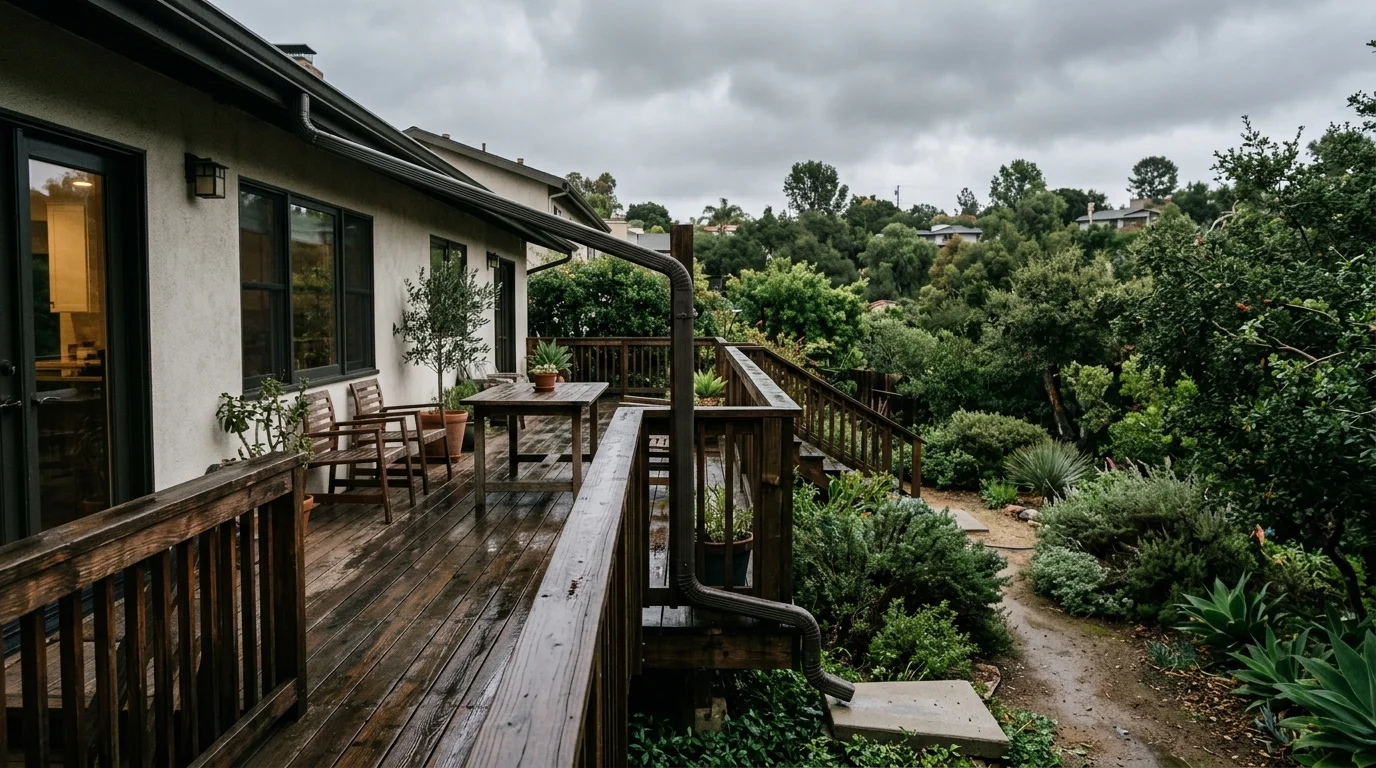
What the first real rain does to a summer-dried deck
Summer here is not a season of steady rain. From June through much of September, the coast lives in the marine layer, that cool fog that wets the surface and then lifts. That is a surface problem, and it is a different job from storm prep. We covered it in marine-layer deck maintenance in San Diego. The first fall storm is runoff.
Wood that baked in Escondido, El Cajon, or Ramona has shrunk. Board gaps widened. End grain at stairs and rail posts opened. Fasteners that held in dry lumber now sit a little proud. Then a real rain hits, not a five-minute sprinkle. Water sheets off the roof, hits the ledger line, and finds every gap the summer opened.
Coastal decks in Pacific Beach, Ocean Beach, and Imperial Beach do not bake as hard. They sit closer to the house on tight lots. The first storm still drives water into the same three places: the ledger against the stucco, the post bases in soil or concrete, and the low corner where the yard already drains toward the structure.
A coated walking surface can hide that soak. Water slips under a failed coating at a crack, then sits. Composite boards do not drink the way wood decks do, but the framing under them is still lumber. The first rain of the year is when that framing gets its first real drink since spring.
Do not wait for a soft board in January to learn where the water went. Walk the deck now, while the wood is still dry enough to show gaps, rust, and old stain lines.
Walk the deck before the storm hits
Start on a dry afternoon. You want to see the structure, not a wet film. Preparing a deck for rain in San Diego is a walkthrough, not a last-minute stain job against a forecast.
Fasteners first. Look for popped nails, rusted screws, and heads that have sunk through the board face. Tighten what is still snug in sound wood. Leave anything that spins, crumbles, or sits in dark, punky fiber. That is not a screwdriver job.
Posts next. Push each post at chest height. A little flex in a tall rail can be hardware. Movement at the base is different. Check where the post meets the footing or the soil. Look for dirt piled against the wood, irrigation hitting the base, and metal connectors with orange rust. Clear soil away from the grain. Do not bury a post to tidy the yard before rain. That holds water against the wood.
Then the ledger. This is the board bolted to the house, the connection most decks cannot lose. Look at the flashing above it. You want a continuous metal or membrane pan that kicks water out over the ledger, not behind it. Leaves in that gap are a dam. Stucco cracks above the ledger are a path. Dark staining on the siding under the deck line is a record of past leaks.
Last, walk the yard as if the storm already started. Point at every downspout. If a spout dumps onto the deck or against a post, that is a rain problem you already have. Dirt should fall away from the house and the footings, not toward them. Older South Bay and central San Diego lots were often cut flat, so water sits. Hillside pockets from La Jolla to the East County canyons send water downhill into the lowest posts first.
If the ledger flashing is missing, split, or dumping behind the band, stop decorating and start planning deck repair and restoration. Like-for-like board replacement usually does not require a permit in San Diego. Replacing structural members (ledger boards, joists, beams, posts) often does, especially if the repair changes loading or layout. The crew matched to the job checks before quoting and pulls the permit when required.
Wood, composite, and coated decks fail in different ways
A bare or stained wood deck drinks. After a long dry stretch, the first soak raises grain, swells boards against each other, and can cup a board that was already thirsty. Finish that still beads water helps. Finish that has gone dull and gray does not.
There is no San Diego rule that you reseal every year. That calendar line is copied from wetter climates. Check the board. Sprinkle water. If it darkens and soaks in, the finish is done. If it beads, you may still have protection. Confirm timing on the product label. The City of San Diego and the County of San Diego do not publish a deck-stain dry time. Stain makers set their own rain-free windows. If the label wants a dry stretch you no longer have, skip the coat. Trapping moisture under fresh finish is worse than waiting until spring.
The best stretch to stain here is the last run of reliably dry weather, often late summer into September. That is a local pattern, not a code date. Watch the forecast, not a national checklist written for snow and ice.
Composite boards shed surface water. They still trap debris in the gaps. Leaves, palm fiber, and eucalyptus litter hold moisture against the joists. Composite also hides framing. You will not see a stained joist from above. Get under the deck with a flashlight. Look at joist tops, hanger steel, and the ledger line.
Coated decks, the elastomeric walking surfaces over plywood, fail at cracks, seams, and the door threshold. A blister or a hairline at the house wall is enough. Once water is under the coating, it travels. The surface can look fine while the plywood stays wet through a whole storm series.
None of these materials make the posts or the ledger waterproof. The wearing surface is what you see. Storm damage starts at the connections.
Where winter water actually comes from in San Diego
People blame the rain total. Around here, three sources do more work than any storm chart, and those inch-per-year figures are not something to guess. If you want a station number, ask the National Weather Service. What you can see on the lot is enough.
Roof runoff is first. One downspout can put a roof’s worth of water on a four-foot strip of deck. Gutters clogged with palm fiber and pine needles overflow at the ledger. A splash block aimed at the house is a leak in slow motion. Clean the gutters. Extend the spout past the deck edge if you can do that without cutting structure.
Irrigation left on is second. San Diego yards run timers through October as if it were still August. A rotor that kisses a post base every morning will wet that wood more days than the first three storms combined. Walk the system at dawn. Move or cap heads that hit the deck, stairs, or footings. Inland clay in Vista, San Marcos, and Escondido holds that extra water against the grade.
Bad grade is third. A patio that pitches toward the slider, a planter built against the ledger, a dog path that became a ditch: those are winter water. Coastal lots in Mission Beach and Imperial Beach are often small and already low. East County pads can sit on cut-and-fill. The fill side settles and leaves a trough at the house. You do not need a rainfall chart to see a puddle.
Furniture, rugs, and heavy planters trap a fourth kind of water: still, shaded wet. Lift them. Let the boards dry from both faces before the first storm locks that moisture in.
Winterizing a wood deck in San Diego is not snow shovels and ice melt. Those tips belong to freeze-thaw cities. Here it means stopping roof water, irrigation, and bad grade before they sit in the framing.
What you can tighten now, and what a pro should open
Homeowners can sweep the gaps, pull leaves from flashing, clear post bases, redirect a downspout, shut off a misaimed sprinkler, snug a loose screw that still bites wood, and lift rugs and planters. That is real prep. It is also the limit for most people.
Do not start pulling ledger bolts, cutting out joists, or peeling a coating because a board looks tired. Opening the connection at the house is structural work. The professionals we connect you with are licensed and insured. Deck Pro SD is a referral service. It matches you with independent local deck builders. It does not hold a contractor license, own a crew, or pull permits. The crew pulls the permit in its own name when the work needs one.
A spinning fastener, a post that moves at the base, rusted hangers, a gap between ledger and stucco, or a stair that flexes underfoot: those are reasons to stop and match with a pro. Targeted repairs to a ledger, joists, or post base commonly run $500 to $8,000 depending on scope. Full structural repair or rebuild of the affected section commonly runs $8,000 to $25,000. Once a licensed crew is on the job, most repairs finish in 1 to 5 days. Structural rebuilds take 1 to 3 weeks. Those are published ranges for this kind of work in San Diego, not a bid for your address.
If you want to confirm a contractor, use the Contractors State License Board license lookup. For permit questions inside the City of San Diego, start with Development Services. Unincorporated county addresses are reviewed by the county, not the city.
The 3-4-5 method that shows up next to this search is a layout check for squaring a rectangle. It is not a rain-season maintenance rule. Skip it for this walkthrough.
When a soft spot after rain is framing, not finish
A board that darkens and then dries after a storm is doing what wood does. A board that stays dark, feels spongy, or bounces under one foot is different. Press with a screwdriver in an inconspicuous spot. Finish failure is surface. Framing failure is the joist or ledger giving up.
Softness at a post base, at the ledger, or along a joist line after the first rain is the usual path into dry rot at the ledger board. That is not a stain issue. Water has been sitting in the connection, often through more than one season. The storm only made it obvious. A deck leaking after rain at the house wall is almost never just the boards.
On older coastal housing, the ledger has had decades to rust and rot. Del Mar has 69.4% of homes built before 1978. Imperial Beach sits at 62%. Both are older than most of the county, where the median pre-1978 share is 48.1%. Inland San Marcos is much newer, at 23.8%. Age is not destiny. An original ledger with tired flashing is still the first place to look.
If the deck is on a building with three or more multifamily units, California requires inspection of exterior elevated wood elements on a set cycle. Deck Pro SD does not perform those inspections. A qualified inspector under the statute has to. For a typical single-family deck, you do not need that frame. You need an honest look at whether the bounce is a board or a beam.
Do not keep loading a spongy corner with planters until spring. Get a licensed deck builder under it while the rest of the structure is still dry enough to work.
When to call us
If fasteners spin, ledger staining is climbing the stucco, a post moves at the base, or a board stays soft after the first rain, that is licensed deck work, not a weekend rinse. Call us at (858) 400-4918, leave a message, and we’ll connect you with a licensed local deck builder.