Deck Pro SD connects homeowners seeking a dry rot repair company in Imperial Beach with licensed, independent local deck builders. The same referral service covers Chula Vista and Coronado, but each property needs its own documented repair scope. Coastal exposure, connections, drainage, and framing should all be discussed before you choose a plan.
Coastal exposure needs its own repair questions
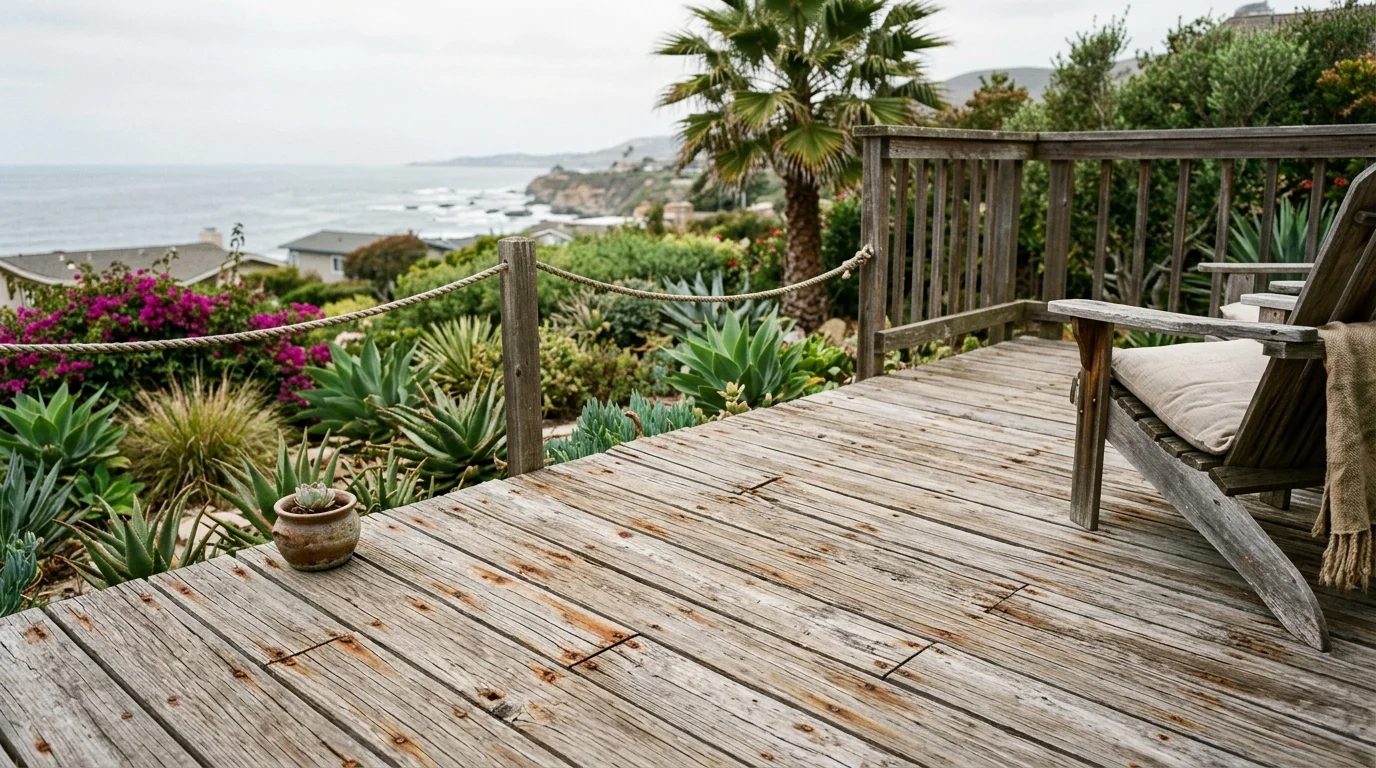
Near the water, look for the conditions that keep wood damp: salt residue on hardware, boards that stay wet long after a marine-layer morning, and shaded corners that never fully dry. None of that diagnoses a deck on its own. A contractor still needs to document what is happening at your property.
No verified citywide corrosion rate or deck-drying timetable could be confirmed for Imperial Beach, Chula Vista, or Coronado. Your distance from open water also doesn’t create an automatic repair scope. Ask the builder to separate visible findings from assumptions about the neighborhood.
Start with the places where water may collect or enter. Ask for photos of board ends, rail posts, stair connections, and framing beside the house. If the deck sits over a room, doorway, or occupied area, include that condition in the written scope. Our guide to rooftop and balcony decks explains the related services available through local pros.
A useful proposal should identify the affected pieces by name. It should also state what remains in place. Words such as “coastal damage” or “dry rot throughout” aren’t specific enough without supporting photos or measurements.
Imperial Beach homeowners can also review our local deck builder referral page before requesting a match. Deck Pro SD doesn’t diagnose damage or perform repairs. We connect you with a licensed and insured independent professional who can inspect the property.
Start the inspection at every metal connection
Corroded screws, brackets, bolts, or hangers deserve attention during a deck inspection. Still, visible rust doesn’t establish the condition of concealed wood. It also doesn’t prove which part failed first.
Ask the builder to photograph each questionable connection before covering or replacing it. The written findings should identify the connector, the surrounding wood, and any movement or separation observed there. If removal is needed to inspect concealed areas, ask where that investigation starts and stops.
Don’t accept “the fasteners caused everything” without supporting findings. Likewise, a clean-looking screw head doesn’t document the condition behind a board or bracket. The repair scope should explain what the contractor could see, what remains concealed, and what further removal may reveal.
Connections near stairs and guards need clear documentation because repair decisions may reach more than deck boards. Under the California Residential Code, guards are required along certain open walking surfaces located more than 30 inches above the floor or grade below. California deck guards must be at least 42 inches high. Their openings generally can’t allow a four-inch sphere to pass.
Those figures don’t diagnose rot. They matter if a repair changes an existing guard or exposes work that needs review. Ask the matched professional whether the proposed scope affects a guard, stair, or handrail. If it does, the proposal should distinguish structural work from finish work.
Beachfront and bayfront conditions need property-level findings
A beachfront or bayfront address may lead a contractor to discuss blown salt, sand, moisture, and exposed hardware. Those subjects belong in the inspection conversation. They shouldn’t be presented as measured facts about your deck without property-level evidence.
Ask which deck faces receive the most exposure. Note nearby walls, planters, roof edges, and other surfaces that may affect the area being repaired. Document where boards remain damp, where coatings have opened, and where metal has changed appearance. These observations give the contractor something specific to evaluate.
No single hardware material or coating can be declared correct for every South Bay property from city name alone. Product selection should follow the repair design, the manufacturer’s written instructions, and the requirements of the jurisdiction handling the permit. Our guide to decking for San Diego’s coastal salt air offers more questions for comparing material proposals.
Elevated balconies need the same property-specific approach. A stain below a balcony, a loose surface board, and damage at the wall don’t automatically describe the same repair. Ask the professional to state which components were inspected and which were concealed. Our San Diego balcony repair guide covers that conversation in more detail.
The goal isn’t a broad coastal label. It’s a written explanation tied to the deck in front of you.
Older Imperial Beach homes call for careful scoping
The U.S. Census Bureau’s 2023 American Community Survey reports that 62% of Imperial Beach homes were built before 1978. That share is above the 48.1% median across San Diego County places with comparable Census data.
This doesn’t prove the age of any deck. It also doesn’t establish when a ledger, rim, balcony, or stair assembly was built. A house may have received additions or repairs after its original construction.
Treat the housing figure as a reason to verify records and conditions, not as a diagnosis. Ask the property owner for available plans, permits, invoices, and product information. Then ask the contractor to compare that paperwork with the construction visible during the inspection.
Don’t borrow Imperial Beach’s figure for Chula Vista or Coronado. Check the individual property’s records and confirm permit history with the jurisdiction responsible for that address.
Older and newer properties can both contain concealed work. What matters is whether the proposal identifies the existing assembly accurately. Look for clear references to posts, beams, joists, rim boards, ledger connections, flashing, guards, and stairs where applicable.
If the contractor can’t inspect an area before demolition, the proposal should say so. It should also explain how additional findings will be documented. That keeps an uncertain condition from being presented as a settled repair before the wood is opened.
Put coastal details into the written scope
A coastal repair proposal should turn general material language into specific selections. If a contractor recommends hot-dip galvanized or stainless hardware, ask for the exact product and installation detail. Neither term alone explains compatibility with every connector, fastener, coating, or piece of treated wood.
A specific local rule requiring one of those materials for every deck repair couldn’t be confirmed for Imperial Beach, Chula Vista, or Coronado. Verify the choice with the contractor, the product manufacturer, and the local building authority when permits apply.
Use the same approach for sealed cuts. Ask what product will be applied, which cuts receive it, and which written instruction supports that method. Don’t accept a vague promise that every exposed edge will be “coastal protected.”
The drainage detail also belongs on paper. Ask for a drawing or written description showing where water is intended to go around the repaired area. If the contractor calls something a drainage plane, request the layers, termination points, and affected wall or deck components. That makes the term reviewable before work begins.
A useful scope may address:
- The exact boards and framing scheduled for removal
- The connector and fastener products being proposed
- Treatment of field cuts and drilled openings
- Flashing or drainage details included in the repair
- Areas that remain concealed until work begins
- Photos required before replacement materials cover the area
Product and drainage choices remain the independent contractor’s responsibility. Deck Pro SD doesn’t select materials, write repair specifications, or warrant the completed work.
Match the scope to the inspection findings
Targeted San Diego deck repairs involving a ledger, joists, or a post base generally run from $500 to $8,000, depending on scope. A full structural repair or rebuild of the affected section generally runs from $8,000 to $25,000. These are market ranges for repair work, not Deck Pro SD prices.
Most repairs finish within one to five days. Structural rebuilds take one to three weeks. Your contractor’s schedule may differ after inspection, material selection, and permit review. Ask for the scope, price, and proposed schedule in writing before contracting directly with the professional.
Only the property inspection should determine whether a ledger or rim needs removal. If a builder proposes that work, ask what was observed and how far the suspected damage extends. The proposal should distinguish investigation from confirmed replacement.
Like-for-like board replacement usually doesn’t require a permit in San Diego. Replacing structural members, including ledger boards, joists, beams, or posts, often does. Permit review becomes especially relevant when the repair changes loading or configuration.
When a permit is required, the independent crew matched to the job pulls it in its own name and schedules inspections. Deck Pro SD doesn’t pull permits or file documents. Confirm the requirements with the jurisdiction responsible for the property before work begins.
You can compare common scopes on our deck repair and restoration service page. Before hiring, verify the specific contractor through the California Contractors State License Board license check. You will contract with and pay that independent professional directly.
When to call us
Call when suspected damage reaches framing, a ledger, a rim, stairs, a guard, or an elevated balcony. Those conditions call for a licensed deck builder to inspect the property and define the repair scope. Call us at (858) 400-4918, leave a message, and we’ll connect you with a licensed local deck builder.