A soft board or damaged post base can change how you use your deck. If you’re looking for a dry rot repair company in Lakeside, Deck Pro SD can connect you with licensed and insured independent local pros. The same referral service covers Santee, Alpine, Spring Valley, and the rest of San Diego County.
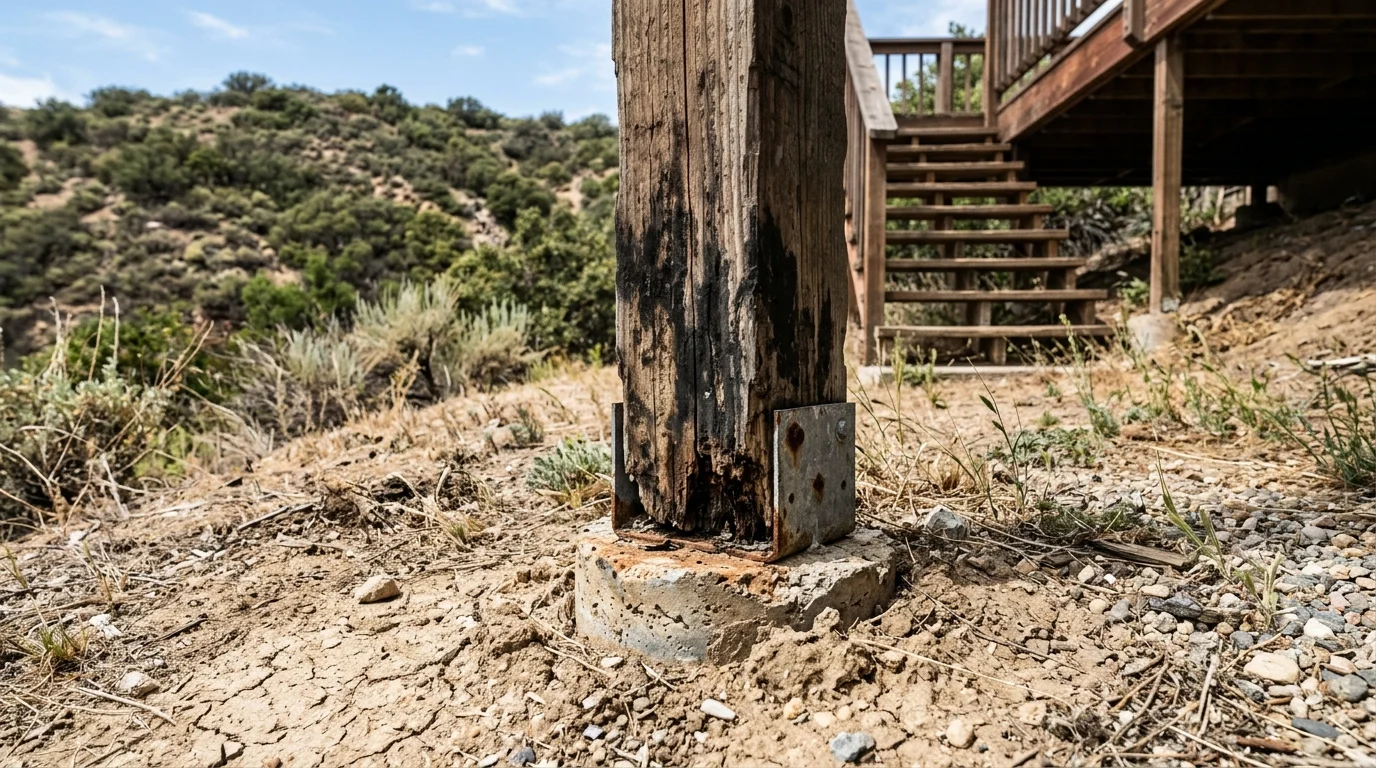
Start with the actual moisture source
Don’t assume a dry-looking East County yard rules out wood damage. A deck may look dry during the inspection while still showing staining, softness, or separation around one connection.
We couldn’t confirm a primary local source proving that irrigation overspray, wet-dry cycling, or shaded north walls cause most deck rot in Lakeside. Those conditions should be treated as inspection leads, not a diagnosis. A contractor needs to examine the affected wood and the conditions around it.
Begin with what you can document. Note whether a sprinkler reaches the post base. Photograph staining after the irrigation runs. Check whether a planter touches the deck edge. Look for water collecting near framing after rain or landscape watering. If the damaged area sits beside a wall, record where the deck and wall meet.
This evidence helps the matched pro evaluate the site-specific problem. It also keeps the conversation focused on the source, not just the visible surface.
Coastal maintenance advice often discusses persistent marine moisture. That context can still help explain what contractors examine, but it shouldn’t be treated as an inland diagnosis. Our guide to deck maintenance around San Diego’s marine layer covers that different setting.
For an East County property, ask the contractor to explain what was observed at your address. Don’t accept a rainfall estimate or neighborhood assumption as proof. The cause, damage depth, and repair scope need to come from the deck itself.
Point out these three conditions
Three conditions deserve attention during an inland deck inspection. None confirms rot by itself. Each gives the contractor a specific place to examine.
First, show the pro any post base reached by a sprinkler. Include the spray direction and the wood’s condition near ground level. Staining, cracking, or softness should be documented without declaring the post structurally sound or unsound.
Second, identify planter boxes placed against the deck edge. The contractor can determine whether the planter contacts decking, trim, or the rim area. Ask whether selective access is needed to see the concealed side. Moving a planter may reveal a surface that hasn’t been visible during normal use.
Third, point out any deck edge built close to stucco. Don’t guess about hidden flashing or required clearance. Ask the contractor to explain what can be seen, what remains concealed, and whether any opening is needed for a reliable assessment.
We couldn’t confirm one local clearance rule that applies to every property in Lakeside, Santee, Alpine, and Spring Valley. The correct authority depends on the jurisdiction governing the address. The matched pro should confirm current requirements before quoting regulated work.
A damaged wall connection deserves added attention because it may involve the deck ledger. Our guide to dry rot and ledger board repair explains how that connection affects repair planning.
For help finding the right local professional, visit our Lakeside deck builder service page. Deck Pro SD makes the connection. The homeowner contracts and pays the independent professional directly.
Check the wood without guessing at the scope
A soft spot under paint or stain doesn’t reveal the full repair scope. It may be limited to a board or continue into supporting framing. A surface observation alone can’t settle that question.
Start with photographs and written notes. Mark the location without driving fasteners into the wood. Record movement, softness, discoloration, open joints, and changes since you first noticed the problem. Tell the contractor whether the area feels different after rain or irrigation.
Don’t treat a screwdriver test as a structural verdict. Pressure, angle, coatings, and access can change what you feel. A licensed deck professional can decide which components need closer examination and whether concealed areas must be opened.
Ask for the assessment to separate visible damage from unconfirmed conditions. Useful questions include:
- Which component appears affected?
- Is the concern limited to a deck board?
- Are the ledger, joists, beam, posts, or post base involved?
- What must be opened before the scope is confirmed?
- Which moisture source was observed?
- Does the proposed work replace structural members?
These questions create a clearer path into deck repair and restoration. They also help distinguish cosmetic work from a structural repair.
If you’re comparing contractors, verify each license through the California Contractors State License Board. Deck Pro SD doesn’t hold a contractor license or perform the inspection. We connect homeowners with licensed, independent local deck builders.
Avoid approving a broad rebuild based only on one soft surface. Also avoid assuming the problem ends where the finish looks normal. The professional examining the deck should document why each component is included.
Let the framing tell you its age
A home’s construction period can guide the first conversation, but it doesn’t establish the deck’s age. Decks can be added, expanded, resurfaced, or repaired after the house was built. Ask for property records and visible construction details instead of relying on appearance.
Alpine offers one useful point of context. U.S. Census Bureau data shows that 31.6% of Alpine homes were built before 1978. That’s below the 48.1% median among San Diego County places with matching Census data. Those figures describe housing stock, not the condition or age of a particular deck.
We couldn’t confirm a comparable housing-age figure for every Lakeside, Santee, or Spring Valley property from the public data used here. Check the U.S. Census Bureau’s current ACS table B25034 for community-level context. For one address, ask the authority governing that property about available permit history.
During the inspection, the contractor should identify what’s visible rather than assigning an age without records. Connections, repairs, coatings, and mixed materials may suggest questions, but they aren’t a substitute for documentation.
Age matters mainly because the present structure controls the repair. A newer board can sit over older framing. One section may have been replaced while a ledger or post remained. The repair proposal should name the actual component, its observed condition, and the work being proposed.
If structural members are involved, review our permits and structural service. The independent crew matched to the job checks the permit question before quoting. When a permit is required, that crew pulls it in its own name and schedules the inspections.
Know when repair becomes rebuilding
San Diego deck repair pricing depends on the affected components and scope. Approved local ranges place targeted repairs involving a ledger, joists, or a post base between $500 and $8,000. A full structural repair or rebuild of the affected section runs from $8,000 to $25,000.
Those are repair ranges, not Deck Pro SD prices. Deck Pro SD doesn’t set prices or provide warranties. The independent contractor quotes the work, contracts with the homeowner, and sets any warranty terms.
Most repairs finish in one to five days. Structural rebuilds take one to three weeks. These are published repair timeframes, not arrival or scheduling promises. Access, inspection findings, permits, and the final scope can affect an individual project.
The clearest dividing line is the work being proposed. Replacing isolated material is different from rebuilding an affected structural section. Ask the contractor to list every ledger, joist, post base, beam, post, or board included. The quote should also identify anything that remains subject to further inspection.
Permit treatment also changes with scope. Like-for-like board replacement usually doesn’t require a permit in San Diego. Replacing structural members often does, especially when the work changes loading or configuration. The matched crew checks before quoting and pulls the permit when required.
Don’t let a general phrase such as “rot repair” hide the difference. Ask whether the proposal covers a targeted repair, structural repair, or rebuild of the affected section. Then compare that answer with the documented conditions.
If the deck can’t be fully assessed from exposed surfaces, ask what selective opening is proposed. That step should have a defined purpose. It should identify the component the contractor needs to see and how the finding may change the scope.
Keep water away from the repaired area
A repair plan should address the damaged wood and the conditions around it. For an inland property, ask direct questions about grading, sprinkler heads, flashing, planters, and clearance. Don’t assume one correction applies to every deck.
Have the contractor identify any irrigation reaching the structure. If a sprinkler head needs adjustment, ask who will handle that separate work. Photograph its position before the deck repair begins. This creates a record of the condition discussed during the inspection.
Ask how nearby soil or hardscape relates to the post base. We couldn’t confirm a universal grading measurement for every East County address. The contractor should check the rule for the jurisdiction governing the property and explain any proposed change.
At wall connections, ask what flashing is visible and what remains concealed. Don’t accept a claim about hidden material unless the area has been examined. If the repair includes a ledger, require the proposal to describe that scope clearly.
Clearance around planters, stucco, and framing also needs an address-specific answer. No minimum covering all four named communities is published in a verifiable source. The contractor should confirm current requirements with the local permitting authority before regulated work begins.
Finally, agree on what you’ll be able to inspect after the repair. Photographs can document concealed work before it’s covered. Permit inspections, when required, are scheduled by the independent crew that pulled the permit.
The goal isn’t a generic promise that the deck will stay dry forever. It’s a clear record of the observed damage, the approved repair scope, and the site conditions addressed by the contractor.
When to call us
Call when softness, staining, movement, or damaged structural wood needs evaluation by a licensed deck building pro. Deck Pro SD will match you with an independent local professional serving Lakeside or another San Diego County community. Call us at (858) 400-4918, leave a message, and we’ll connect you with a licensed local deck builder.