Deck removal in San Diego starts with one decision: remove everything, or preserve part of the structure for repair. The right scope depends on what remains, what replaces it, and what the licensed contractor finds. Deck Pro SD can connect you with an independent local pro who can assess those choices.
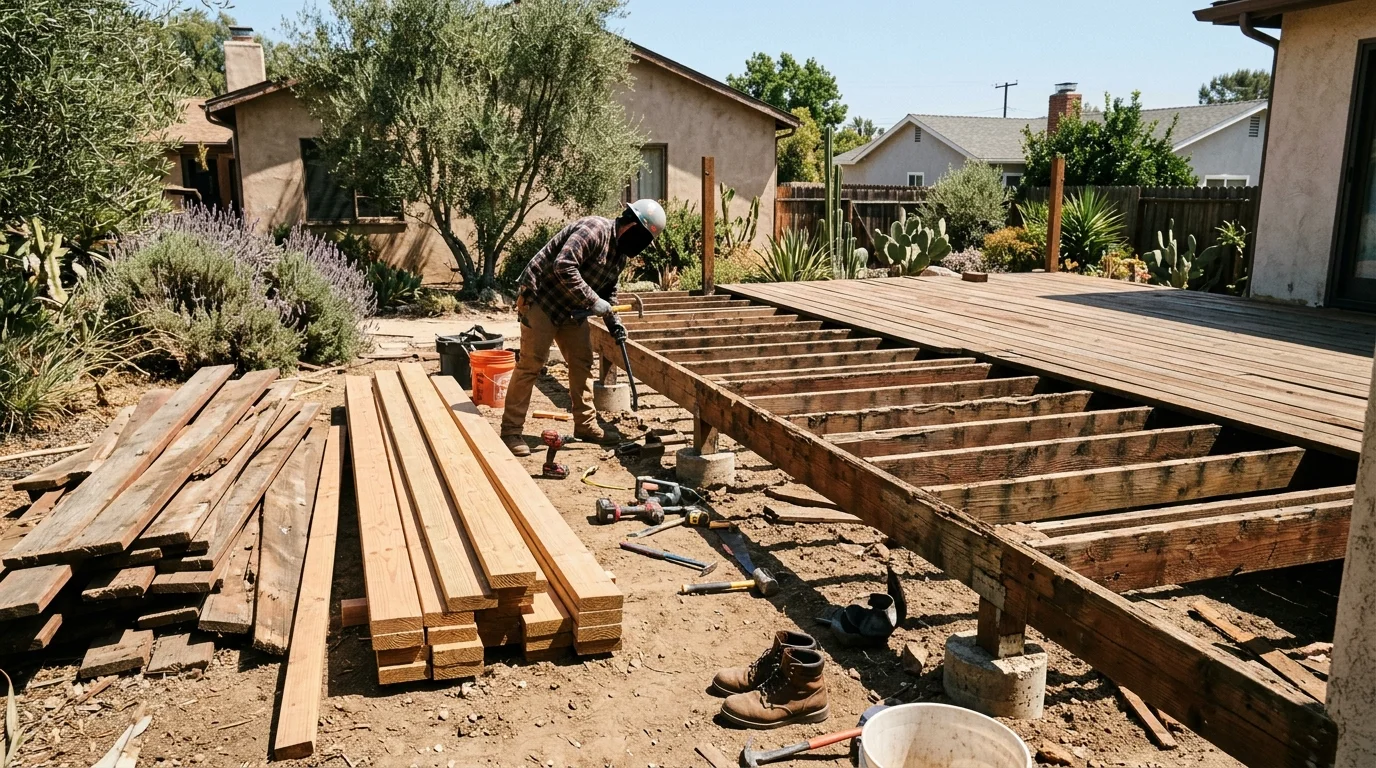
Decide whether removal or repair fits the project
Start with the result you want. You may want the deck gone and the footprint cleared. You may want a smaller deck, a patio, or a complete replacement. Another homeowner may only need damaged components addressed.
Use a component-by-component review before choosing demolition. Ask the contractor to address the boards, railings, stairs, framing, ledger, posts, and footings separately. The written scope should identify what can stay, what should come out, and what can’t be judged before work begins.
Repair pricing can help frame that decision. Published San Diego ranges for targeted deck repair and restoration run from $500 to $8,000, depending on scope. A structural repair or rebuild of the affected section runs from $8,000 to $25,000. Most repairs finish in one to five days. Structural rebuilds take one to three weeks.
Those figures cover repair work, not deck removal. We couldn’t confirm a reliable San Diego market range for demolition alone. Ask each contractor to separate removal, disposal, wall repairs, permit work, and replacement construction. That makes competing proposals easier to compare.
Don’t let the deck’s appearance settle the question. Instead, ask what physical findings support the recommendation. If some conditions remain hidden, the proposal should explain how changes will be approved after exposure. That gives you an honest decision without pretending every condition is visible at the start.
Review demolition in clear phases
Organize the removal scope in five phases: railings, decking, framing, ledger, and footings. A contractor may choose another working sequence for the property. The proposal should still address every phase.
For railings, ask whether posts and attached gates are included. For decking, confirm whether the scope covers every board, stair tread, and built-in feature attached to the deck. If anything will stay, have it named in writing.
The framing phase should identify which joists, beams, posts, and connections will be removed. These are structural members. Approved San Diego repair guidance says replacing structural members often requires a permit, especially when loading or configuration changes. Demolition has its own permit questions, so don’t treat the repair guidance as a universal removal rule.
Give the ledger its own line in the scope. Ask what happens when it comes off and what wall condition would trigger additional work. The proposal should also explain how any exposed exterior area will be evaluated before it’s covered.
Footings need a written decision too. Ask whether they’ll be removed, retained for review, or left for another project. Don’t let the phrase “deck demolition” decide that detail by implication.
Before hiring, confirm the contractor’s status through the California Contractors State License Board. Deck Pro SD matches homeowners with licensed and insured independent pros. The homeowner contracts with and pays the selected professional directly.
Plan for the wall behind the ledger
The deck may disappear while a wall repair remains. If removing the ledger exposes unfinished, damaged, or mismatched material, that condition needs a separate response. Photos taken before demolition may not show what sits behind the connection.
Ask the contractor how the proposal handles stucco, siding, trim, coatings, and other exterior finishes. The scope should say whether those items are included, excluded, or priced only after exposure. It should also identify who will assess the opened area.
Don’t assume a general demolition line includes finish work. A deck contractor’s proposal may stop after removing the deck components. Another proposal may include specific wall restoration. Compare the words, not just the total.
Color and texture matching deserve attention before work starts. Ask what “complete” means if patched stucco or replacement siding doesn’t match the surrounding wall. If painting is excluded, make sure that exclusion is visible in the written scope.
You should also decide how approval works if hidden wall work appears. The contractor can document the condition, explain the proposed response, and provide a written change before proceeding. Avoid an open-ended allowance based on an unseen condition.
This is the part many removal plans overlook. It isn’t responsible to publish a standard San Diego wall-repair price without a verified source and a known condition. Ask for a property-specific written scope after the area can be evaluated.
Confirm permits with the correct jurisdiction
There isn’t one confirmed demolition answer that covers every address in San Diego County. The requirement is a question for the jurisdiction responsible for the property. Deck height, structural changes, the replacement plan, and the submitted scope may affect that review.
For a property within the City of San Diego, start with Development Services. Describe the existing deck, the proposed removal, what will remain, and what will replace it. Ask whether demolition approval, plans, inspections, or another city review applies.
For an address elsewhere, contact the jurisdiction serving that address. An El Cajon deck project, for example, shouldn’t rely on an answer given for a City of San Diego property. We couldn’t confirm a countywide demolition rule or fee that safely answers every local case.
Published repair guidance provides a useful boundary. Like-for-like board replacement usually doesn’t require a San Diego permit. Replacing ledger boards, joists, beams, or posts often does, especially when the work changes loading or configuration. That statement covers repairs. It doesn’t confirm whether a specific demolition needs approval.
Ask the permit office direct questions. Does removing the entire deck require a permit? Does retaining posts or footings change the answer? Does a future patio or replacement deck need a separate application? Get the current answer for the address before approving the scope.
The independent crew matched to a permitted project pulls the permit in its own name and schedules required inspections. Deck Pro SD doesn’t file permits or perform the work. Our permits and structural service and San Diego deck permit guide can help you prepare questions for the contractor.
Define disposal before demolition begins
Haul-off should be specific. Ask whether the proposal covers sorting, loading, transportation, facility charges, and final site cleanup. If a container will remain at the property, confirm who coordinates its placement and removal.
We couldn’t confirm one current dump fee for deck debris across San Diego County. We also couldn’t confirm one acceptance rule covering pressure-treated lumber at every receiving facility. The selected transfer station, landfill, or disposal yard sets its current rates and acceptance requirements.
Contact the intended facility before work begins. Describe the material accurately, including pressure-treated wood, painted boards, fasteners, concrete, and mixed debris. Ask whether materials must be separated and what documentation the facility requires. Confirm the current rate directly with that facility before paying.
The contractor’s proposal should identify which disposal charges are included. Ask whether concrete footings, railing materials, built-ins, and loose debris fall within the same line. If the facility rejects a load or requires different sorting, the contract should explain how that change gets handled.
Site access should appear in the removal plan as well. Document where debris can be staged, where a vehicle or container may stand, and which surfaces need protection. If the route crosses a shared area, ask the property owner or association what permission is needed. Don’t assume the deck contractor controls a shared driveway, curb space, or community rule.
A clear haul-off scope prevents the empty footprint from becoming a storage area for boards and concrete. It also lets you compare proposals without guessing what “debris removal included” means.
Choose what happens to the empty footprint
Decide the next use before finalizing demolition. The main choices are an open yard, a patio or hardscape project, or another deck. Each choice creates different questions for the old posts, footings, wall area, stairs, and surrounding grade.
Don’t assume existing posts or footings can support a new deck. Ask the licensed professional responsible for the replacement to evaluate them. The permit authority should also confirm what the submitted plans must show when existing components remain.
If you want a new deck in the same location, coordinate the removal and replacement scopes. One document should identify what stays. The other should identify what the replacement design depends on. Our San Diego deck cost guide can help organize your budgeting questions, but the contractor must price the actual design and site.
A patio or hardscape needs its own defined scope. Ask who removes unwanted footings, prepares the footprint, handles drainage questions, and completes the new surface. Deck Pro SD connects customers with deck builders. It doesn’t promise that a matched deck professional performs every separate landscape or hardscape trade.
If the area will remain open, define the stopping point. Ask how holes, exposed connections, wall finishes, steps, and retained materials will be addressed. The proposal should describe the condition you’ll receive, not only the pieces being removed.
The best demolition plan works backward from that finished condition. It names retained components, unresolved conditions, and work assigned to another professional. That keeps a simple removal from turning into several unplanned projects.
When to call us
Call when deck removal involves structural members, a ledger, retained footings, permit questions, or a planned replacement. A licensed local deck builder can inspect the property and prepare a scope based on what’s actually there.
Call us at (858) 400-4918, leave a message, and we’ll connect you with a licensed local deck builder.