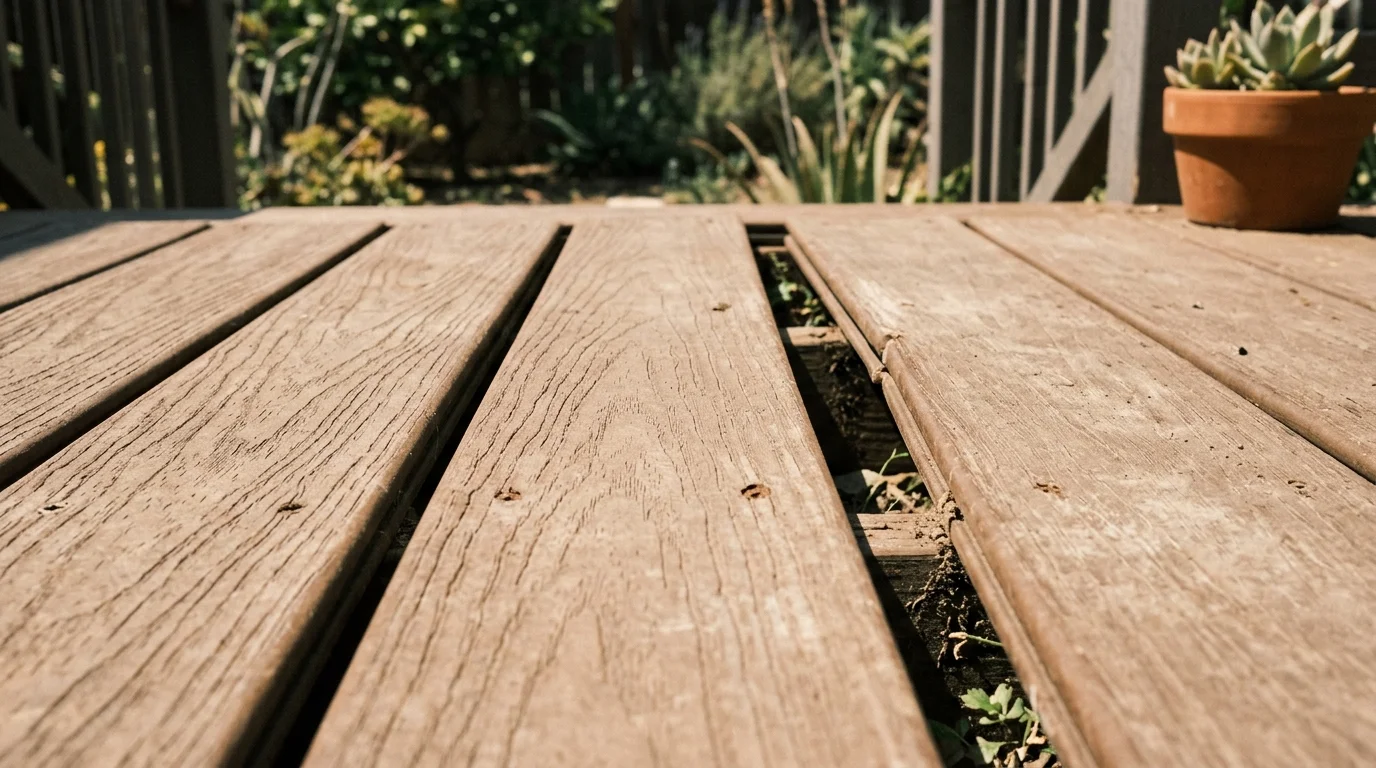
If composite boards are lifting, cupping, or pressing together, do not drive extra screws until you know that product’s gap and fastener rules. Identify the board line, photograph the gaps in sun and shade, and download the current installation guide for that exact product. The visible shape alone does not confirm the cause.
Start with the board maker’s movement rules
A blanket claim that composite responds only to heat and never moisture can’t be confirmed across every product line. Manufacturers publish instructions for specific boards, profiles, fasteners, and installation methods. Those instructions should guide the diagnosis.
Find the product name before measuring anything. Look for purchase records, spare boards, package labels, or markings on an accessible board end. Don’t identify a product from color alone. Similar-looking boards can come from different lines.
Next, download the current installation guide from the manufacturer. If possible, find the version available when the deck was built. Record any differences between those documents. Don’t borrow a gap or support number from an unrelated product.
A useful inspection compares the deck with those written requirements. It doesn’t begin with a general rule from another climate or another board line. The check should cover board ends, side gaps, support layout, fastening, breaker boards, and framed borders.
Material choice still matters when planning a replacement. This guide to composite versus wood decking in San Diego explains the broader decision. Homeowners comparing major composite brands can also review Trex versus TimberTech, then confirm every technical detail with the current manufacturer documents.
For an existing deck, don’t assume the material itself has failed. First determine whether the installed system matches the instructions written for that exact product.
Read the gaps as installation evidence
Record end gaps separately from spaces along the board sides. Also photograph joints where boards meet a wall, border, stair, post, or breaker board. Those locations can show whether the installation matches the product guide.
Don’t compare one random opening with a number found online. Measure several locations using the same method. Note which gaps are even, which are closed, and which have widened. A simple sketch can show whether the change appears in one isolated area or across several rows.
Installation conditions can also matter when the manufacturer’s instructions account for them. If the original paperwork records the installation temperature, keep that information with your measurements. If it doesn’t, don’t invent a figure. Ask the manufacturer how its current instructions address an installation with no temperature record.
Check the entire board length. An end may look open while the opposite end presses against a fixed edge. A framed border can also make the layout harder to read from above. The goal is to map every place where the board meets another surface.
Take dated photographs during different site conditions. Use the same camera angle and place a ruler beside the same joints. That gives a deck builder and the manufacturer something concrete to review.
No universal San Diego gap figure can be confirmed without the board line and its instructions. The correct gap is the one documented for that product, fastening system, layout, and installation condition.
Check the framing under a rippled surface
A rippled board doesn’t prove the framing underneath is defective. It does mean the support layout belongs in the inspection.
Where access is safe, photograph the underside without removing structural parts. Record where the board crosses each joist. Note changes around stairs, borders, openings, posts, and transitions. If access is blocked, leave the inspection to a licensed deck builder.
Compare the actual support layout with the manufacturer’s written installation detail. Don’t substitute a generic joist-spacing number. Ask the manufacturer whether the board profile, board direction, or fastening method changes its requirements.
The inspection should also distinguish a decking issue from visible movement below it. Joists, beams, posts, and ledger boards are structural parts. If one of those components is involved, the work is no longer limited to repositioning a surface board.
That distinction affects repair planning. Like-for-like board replacement usually doesn’t require a permit in San Diego. Replacing structural members often does, especially when the repair changes the loading or configuration. The independent crew matched to the job checks before quoting and pulls the permit when required.
Don’t cover an uncertain framing condition with another layer of decking. A licensed pro can compare the framing, fasteners, and board layout as one system. The deck repair and restoration service is the right starting point when the problem may extend below the walking surface.
Compare sun exposure before blaming board color
A west-facing deck in Santee can receive direct late-day sun. That observation belongs in the inspection, but it doesn’t prove why a board changed shape.
Document the deck’s direction and the hours when the problem looks most noticeable. Note permanent shade, umbrellas, nearby walls, reflective windows, and covered sections. Compare affected boards with boards from the same installation that receive different exposure.
If surface temperature is being investigated, record actual readings instead of guessing. Keep the time, location, weather conditions, tool used, and precise board area with each reading. Send that record to the manufacturer and ask how it relates to the identified product.
There isn’t one confirmed surface-temperature cutoff that applies to every composite board. The manufacturer should identify the limits, installation requirements, and testing method for its product. Dark color alone isn’t enough to confirm the cause.
This matters across San Diego County. A deck near the coast and a west-facing deck farther inland don’t share the same surroundings. The useful report names the actual property conditions instead of assigning one countywide explanation.
Homeowners searching for a deck builder serving Santee should share the deck’s orientation and shade pattern when describing the issue. Those details help the matched professional prepare for a product-specific inspection without pretending the diagnosis is already settled.
Inspect every place the board is held
Fasteners are another checkpoint, not an automatic verdict. A raised or buckled area may sit near a clip, screw, plug, border, or board end. Photograph those relationships before anyone loosens or removes a board.
Identify the fastening system if possible. Compare the installed clips, screws, and spacing with the manufacturer’s guide for the exact board line. Don’t assume that a fastener approved for one product is approved for another.
Pay close attention where the layout changes direction. Picture-frame borders, breaker boards, stairs, and posts can create several connection details within a small area. Each detail should match the product instructions. If the guide doesn’t cover the installed layout, ask the manufacturer for written direction.
Avoid prying up boards simply to test a theory. Removal can erase useful evidence or cause added damage. A licensed deck builder can first document the layout, then decide whether a controlled removal is needed.
The inspection should answer narrow questions. Does the fastener match the identified product? Is it installed as shown? Do fixed edges follow the required detail? Does the affected area differ from sections that remain flat?
Deck Pro SD can connect homeowners with licensed and insured independent professionals who handle composite decking. The matched pro performs the inspection and any physical work. Deck Pro SD doesn’t install boards, alter fasteners, or provide a product warranty.
Separate a local repair from a full relay
Some problems may be limited to one board or one connection. Others may appear across several rows or around multiple fixed edges. The visible pattern helps define the inspection area, but it doesn’t decide the repair by itself.
An in-place correction should only be considered after the product and installation details are confirmed. The deck builder can compare the affected area with the manufacturer’s instructions and inspect the supporting structure. If the surrounding system remains consistent with those instructions, the proposed scope may stay local.
A broader relay becomes a conversation when the same conflict appears repeatedly. The contractor should explain which written requirement the current installation doesn’t meet and how the proposed layout addresses it. Ask for that explanation in writing before approving work.
Structural findings need separate treatment. Like-for-like surface-board replacement usually doesn’t require a permit in San Diego. Work involving ledger boards, joists, beams, or posts often does. When required, the independent crew pulls the permit in its own name and schedules inspections. Deck Pro SD doesn’t file permits.
A manufacturer conversation starts with evidence. Gather purchase records, product identifiers, installation documents, dated photographs, measurements, and written findings from the deck builder. Ask the manufacturer to confirm whether any current warranty applies and what its claim process requires. Don’t assume a coverage term or outcome.
Deck Pro SD gives no warranty and doesn’t decide manufacturer claims. The customer contracts with the independent professional directly. That separation keeps the repair decision, contractor agreement, and manufacturer review clear.
When to call us
Call when boards are lifting underfoot, framing may be involved, or the installation needs comparison with the product guide. The pros we connect you with are licensed and insured, and you can verify a contractor through the CSLB license check. Call us at (858) 400-4918, leave a message, and we’ll connect you with a licensed local deck builder.