Hiring a deck builder in Carlsbad is a lot-by-lot decision, not a coastal template. A Village side yard west of I-5, a lagoon-edge lot, and a pad in La Costa or Bressi Ranch share a city name and almost nothing else. The pro you match with has to plan for salt, humidity, inland sun, HOA review, and how the crew even gets lumber into the yard.
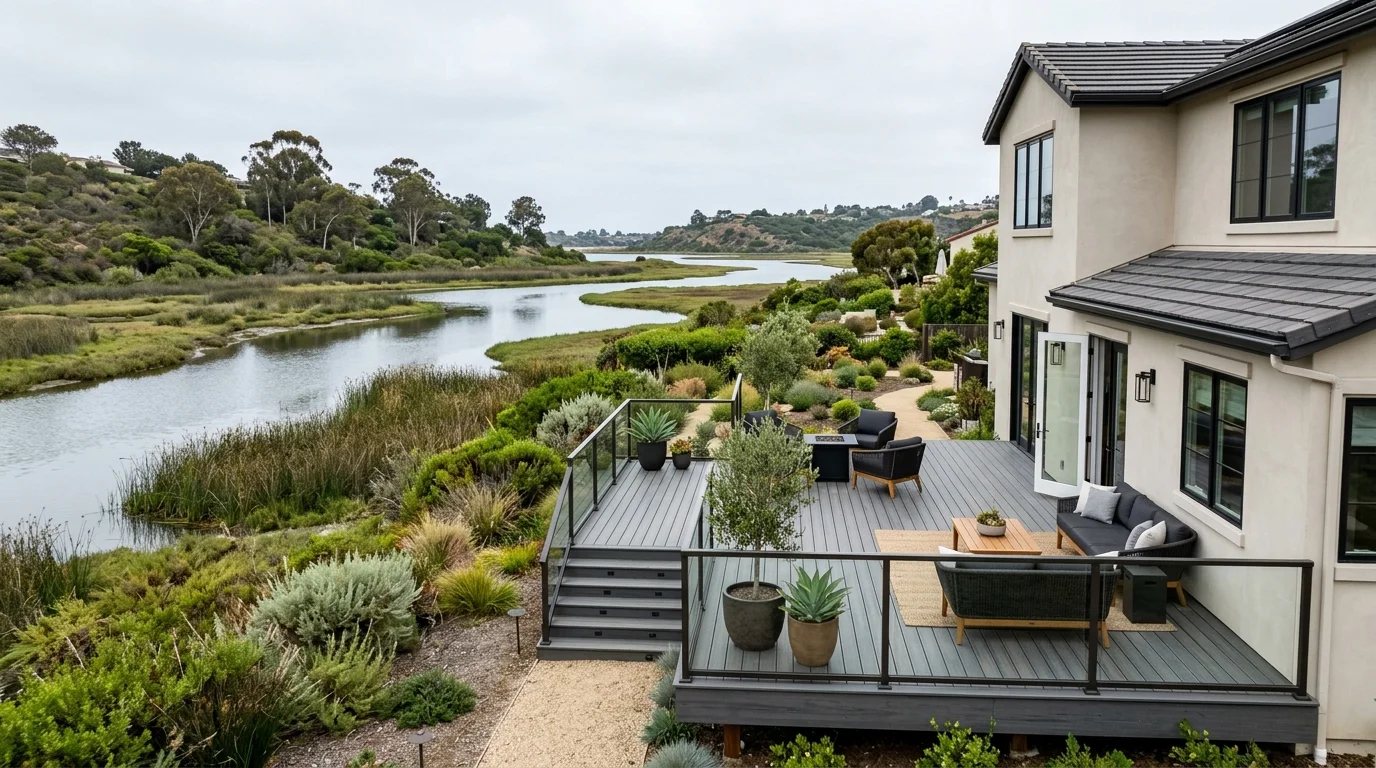
Carlsbad is not one climate: village lots west of I-5 vs La Costa and Bressi Ranch inland
Carlsbad deck construction fails when someone treats the whole city like the beach. West of I-5, around Carlsbad Village and the blocks that drain toward the water, lots are older, tighter, and closer to marine air. East of the freeway, Aviara, La Costa, and Bressi Ranch open up. Yards get wider. Afternoon heat sits on the boards longer. The architecture shifts too: stucco and tile in the planned communities, smaller cottages and infill near the Village.
That split changes the deck before anyone picks a board color. A low platform off a Village kitchen door is a different structure from an elevated deck on a La Costa slope, looking over a canyon. Aviara homes often sit on graded lots with two-story massing, so the walking surface may sit well above grade. Guards, stairs, and ledger flashing matter more there than they do on a near-grade pad in Bressi Ranch.
Lagoon edges add a third condition. Batiquitos, Agua Hedionda, and the Buena Vista lagoon sit inside the city, not out in some other climate. Homes along those edges get damp air even when they are not on the sand. Framing, post bases, and hardware stay wetter than they do a few miles inland. A crew that only builds east of El Camino Real will underspec that. A crew that only builds at the Village will overbuild a flat inland lot and still miss the HOA packet.
The right first question is not “what’s popular in North County.” It is where the house sits on that map. Village, Tamarack-side, Aviara, La Costa, Bressi Ranch, Calavera Hills, Robertson Ranch: each one sets access, exposure, and review. Deck Pro SD matches you with a licensed, independent local pro who prices and details the lot you actually have, not a generic Carlsbad brochure.
Salt air, lagoon humidity, and afternoon heat on the same city map
Salt does not stop at the sand. It rides the marine layer through the Village and along the lagoons. Fasteners, hangers, post bases, and flashing take that load first. Untreated hardware stains, pits, and then lets water into the wood. The walking surface can still look fine while the connection at the house is already in trouble.
Inland, the problem flips. La Costa and Bressi Ranch get more sun hours on the deck face. Color shift, cupping on wood, and hot barefoot surfaces show up sooner than rust. Same city. Different failure. A composite deck in Carlsbad CA that is right for a shaded Village yard can still be the wrong color and gap pattern for a west-facing inland pad that bakes from noon on.
Humidity around the lagoons sits between those two. It is not open-ocean spray every day, and it is not dry inland heat either. It is lingering moisture in the framing cavity, at the ledger, and at grade. Airflow under the deck, slope away from the house, and keeping soil and irrigation off the posts matter as much as the brand name on the board.
None of that is a reason to panic-buy the most expensive product on the rack. It is a reason to walk the site with a licensed pro before you lock a material. Ask where the sun hits at 3 p.m. Ask how close the lagoon or the beach is. Ask how the ledger will flash if the deck ties to stucco. The matched crew sizes hardware and drainage to that, then you pick the surface. For the salt-specific hardware and board conversation, use our guide to decking for coastal salt air in San Diego rather than treating Carlsbad as a copy of Del Mar or Encinitas.
HOA design review in planned communities, confirmed with your association, never guessed
HOA deck approval in Carlsbad is real in Aviara, La Costa, Bressi Ranch, and the other planned tracts. It is not one citywide style sheet. Associations set color ranges, railing looks, height, privacy screens, and sometimes whether the structure can be visible from the street or the golf course. What passed two streets over may still get a rejection letter at your lot.
Do not let anyone guess those rules from memory. Pull the current architectural guidelines from your association. Ask what they want in the packet: plan view, elevations, material cut sheets, neighbor notice, and how they want samples shown. Then have the matched pro draw to that, not to a Pinterest rail that the board has already banned.
Village properties are mixed. Some streets have no association. Some small tracts do. If you have CC&Rs, treat them as a second permit track that runs beside the city’s. The city can approve a structure your board still hates. Your board can bless a look the city still wants engineered. Both have to clear.
Railing is where HOA taste and state code collide. In California, guards on a deck more than 30 inches above the grade below must be at least 42 inches high, not the 36 inches you see in national catalogs. Openings cannot pass a 4-inch sphere. If the association wants open cable or glass for the view, the licensed crew still has to hit those numbers. If the association wants a closed guard with balusters that matches the stucco, that can work too, as long as the height and opening limits are met. Confirm the look with the board. Confirm the height with the code the city enforces.
Multifamily buildings are a separate legal track. California Civil Code 5551 covers inspection of exterior elevated elements on buildings with three or more attached multifamily units. Health and Safety Code 17973 covers similar inspections on apartments. Deck Pro SD does not perform those inspections. If you own in a condo or apartment building, the statutory inspector list is in those laws, and the association or owner still has to follow them. A new backyard deck on a detached house is not the same job.
Materials that take marine layer and inland sun without repeating the coastal-salt guide
Wood still belongs on some Carlsbad homes. It also asks for oil, stain, and honest maintenance in salt and sun. If the household will not do that, do not start with redwood and hope. Inland UV cooks a neglected finish. Lagoon moisture gets under it. Then you are into repair, not a weekend refresh.
Composite decking is the usual match when the owner wants a walking surface that does not need a seasonal coating. It is not magic. It still needs the right framing, gap, fastener, and airflow. Dark boards run hot in inland afternoon sun. Light boards show dust from the canyons. Capped product is the conversation for stain and fade, but manufacturer warranty terms change by line and year, so read the current sheet for the board you are buying. Do not treat a sales claim as a promise from Deck Pro SD. We do not warrant the work. The independent pro and the manufacturer do, each in their own lane.
PVC boards show up on wetter, lower, or pool-adjacent jobs because there is no wood fiber in the plank. Hardwoods such as ipe show up when the owner wants a dense, oil-finished look and will maintain it. Both are site calls, not citywide defaults. Hardware should be corrosion-resistant near the water and the lagoons. Inland, UV-stable color and a framing plan that can take heat and foot traffic matter more than marine spray.
What you should not do is copy a coastal-salt shopping list onto a Bressi Ranch pad, or an inland sun list onto a Village lot 10 feet from a damp side yard. Walk the exposure. Then pick the surface. If an older wood deck is already soft at the ledger, posts, or joists, that is a structure problem first. Targeted repairs and section rebuilds are a different scope from a new build. The crew you match with should say which one you are in before anyone orders boards.
Tight village access vs wide inland lots, and how that changes staging
Carlsbad Village lots often have a side-yard gate, a narrow drive, and neighbors close enough to hear every cut. Lumber, footings, and rail sections may have to come through the house or down a path, not off a truck at the back fence. That changes labor, protection of floors and stucco, and how long the job occupies the street. It also changes whether a long board even fits the turn.
Inland, Bressi Ranch and similar tracts usually give the crew a wider gate, a flatter yard, and room to stage. The work can still be fussy if the HOA limits street parking or dumpster placement. Aviara and parts of La Costa add slope. Materials sit on a grade. Footings step. Temporary access for the crew can chew a landscaped bank if nobody plans the path.
Staging is not a footnote. It is part of the quote. Ask the matched pro how they get material in, where they cut, where debris leaves, and how they protect irrigation and pool plaster if those sit in the way. A cheap board price with a hand-carry through a Village house is not a cheap job. A wide inland lot with a crane-friendly drive is a different day.
Size questions from national charts miss this. A 12x12, 14x20, or 20x20 walking surface is only the rectangle on paper. Height, stairs, 42-inch guards, demo of an old structure, slope, and whether the crew can roll a cart to the back all move the number. Deck Pro SD does not publish new-construction prices. The licensed pro who walks the lot quotes the structure, not a square-foot guess from another state.
Permits sit with the City of Carlsbad
Carlsbad is its own city. Permits and plan review for an address inside the city limits sit with the City of Carlsbad, not with the County and not with the City of San Diego. Unincorporated parcels nearby are a different desk. Confirm the jurisdiction from the address before anyone draws a title block.
What that desk will require depends on the work. In San Diego County work generally, like-for-like board replacement often does not need a permit. Replacing structural members (ledger, joists, beams, posts), changing height or layout, or tying a new deck to the house often does. That is the split to start from. It is not a substitute for asking Carlsbad about your lot. Setbacks, height, easements, and coastal overlay questions are local. A permit exemption, where one exists, is not a zoning exemption.
The independent crew matched to the job pulls the permit in its own name and schedules the inspections. Deck Pro SD pulls no permit, files nothing, and is not a party to it. If the job needs engineering for a slope, a spa load, or an elevated walk, that scope belongs to the licensed professionals on the permit, not to a referral page. For how permits work across the county, read deck permits in San Diego and our permits and structural service notes, then still call the City of Carlsbad for the rule that applies to the street.
Before you sign, look the contractor up on the CSLB license check. Confirm the license is active and matches the name on the contract. The pros we connect you with are licensed and insured. The brand itself is a referral service. You contract and pay the builder directly.
When to call us
Call when the lot is in Carlsbad and you need a licensed deck builder who will deal with salt or inland sun, HOA packets, tight Village access, or a city permit, not a weekend platform kit. Call us at (858) 400-4918, leave a message, and we’ll connect you with a licensed local deck builder.